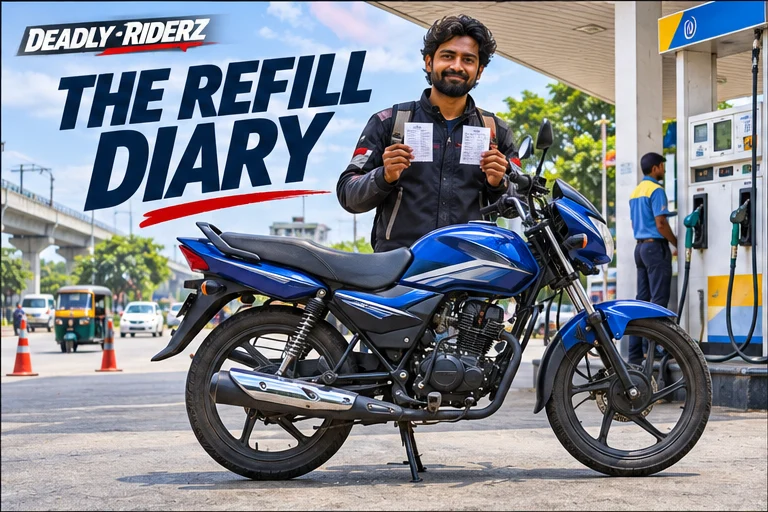

You buy ₹300 of petrol on Monday and ₹500 on Friday. The motorcycle covers 180 km between visits. Which amount belongs in the mileage calculation? Neither receipt gives you the answer on its own. There was fuel left before Monday and fuel left after Friday, and the two amounts may differ. You can keep buying petrol in convenient amounts. You just need two comparable fuel levels to mark the start and finish of the measurement.
Highlights
- Record litres and odometer readings. A rupee amount alone mixes the petrol price with the bike’s consumption.
- Count every refill after the starting fill, including the final one that returns the tank to the starting level.
- Add distance and litres across comparable intervals before dividing. Short and long trips should carry their proper weight.
Give the first receipt a different job
Start at a normal fuel stop. Follow your motorcycle manual’s refuelling instructions, including the specified maximum fill level. Switch off the engine and use a repeatable permitted fill point. Leave the expansion space the manufacturer requires. Write down the odometer reading and mark the receipt “start”. The money spent at this visit is a real household expense. The litres on that receipt establish the starting condition and stay out of this particular consumption calculation.
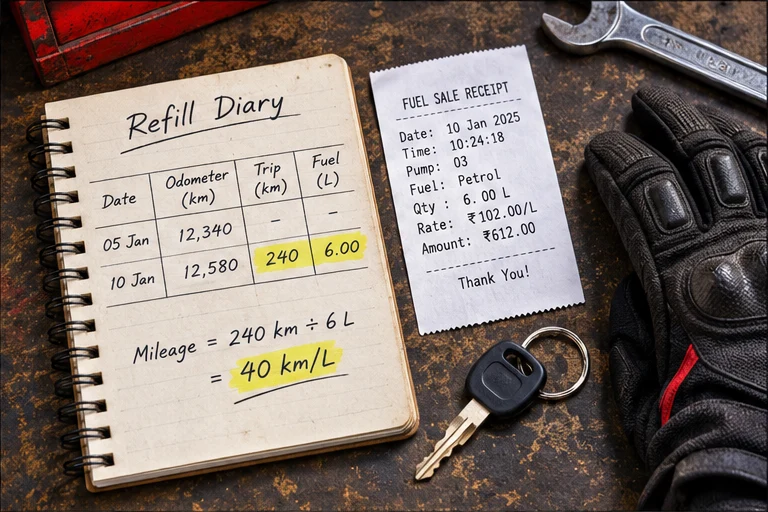
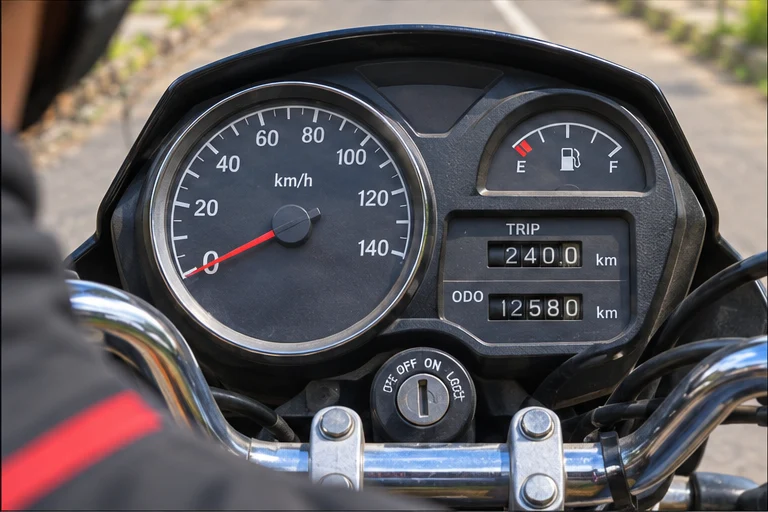
A phone note after leaving the dispenser is sufficient. Use four columns: date, odometer, litres and amount. Add a short route note if this week’s riding was unusual. The odometer gives you a backup if the trip meter is reset while someone else uses the bike. If you share the vehicle, a paper envelope for receipts works as well as an app. Your passenger or family member only needs to know that every purchase goes in it.
A partial refill still counts
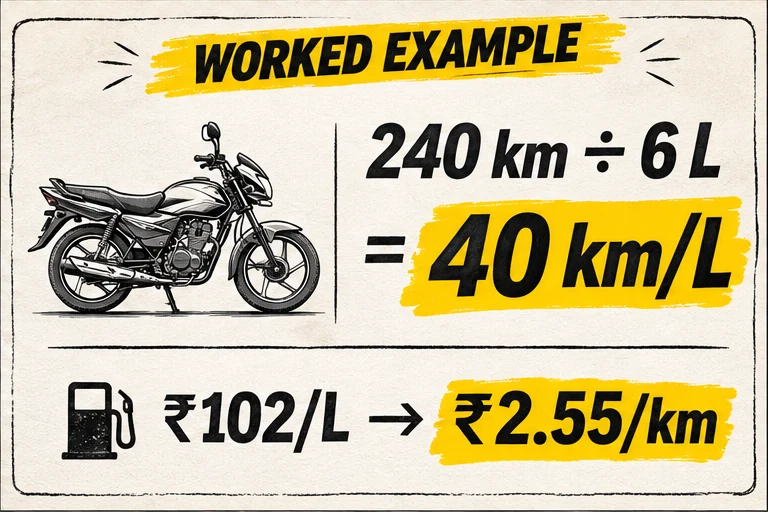
Imagine the starting odometer reads 12,000 km. A few days later you buy 2.0 litres. At 12,240 km you return the tank to the same permitted level as at the start and the dispenser delivers 4.0 litres. The bike has covered 240 km and you have replaced 6.0 litres. Divide 240 by six and you get 40 km/l. The starting receipt could show one litre or eight. It would make no difference to that interval.
Why does the last receipt count when the first one does not? Think of returning a borrowed motorcycle with the same amount of fuel you were given. The 2.0 litres purchased along the way did part of that work. The last 4.0 litres settle the balance. Divide by only the last purchase and the calculation says 60 km/l, a flattering number created entirely by a missing receipt.
Turn mileage into a budget
At an illustrative ₹102 per litre, each kilometre in that example costs ₹2.55 in petrol. At 22 working days and a 24 km daily round trip, the commute covers 528 km. At the same measured consumption, allow about 13.2 litres or ₹1,346 for that commute. Substitute the price printed on your own receipt. The example is arithmetic, not a current Indore pump quote or an efficiency claim for any model.
If prices change between fills, use the litres column for mileage. For a cashflow question such as “How much did we spend on petrol in November?”, total the amounts actually paid in November. These figures can move in different directions. Buying fuel on the last evening of a month moves cash out of the household budget immediately, even if most of those kilometres happen next month.
Read a short interval with care
Suppose a 100 km interval really used 2.5 litres. An end fill that lands 0.2 litre higher would make the calculation about 37 km/l. One that ends 0.2 litre lower would suggest around 43.5 km/l. Neither establishes a mechanical fault or a sudden improvement. The example shows why repeating the same permitted fill point and looking across several refills is more useful than celebrating a single trip meter reading.
Combine intervals by adding the actual distances and the actual litres. A 60 km trip on two litres gives 30 km/l. A 180 km trip on four litres gives 45 km/l. Their simple average is 37.5, but together the bike covered 240 km on six litres, or 40 km/l. Use the combined number when estimating next month’s petrol bill for a similar mix of journeys.
When a receipt goes missing
If you forgot to note the odometer at a partial fill but kept the litres, the overall calculation still works. Only the start and end odometer readings are essential. If you know the amount and the exact unit price charged, divide the amount by that price to reconstruct the litres and mark it as reconstructed. If the litres and unit price are both unknown, close the incomplete entry and start a fresh interval at the next comparable fill. Guessing from the fuel gauge gives a precise-looking answer without a sound denominator.
Keep a separate line for route changes before using the record to make a service decision. A week of short school drops through traffic differs from a Sunday highway run. Compare like with like and look for a repeated change. A persistent decline is more useful to discuss with a workshop when you can show the dates, conditions and litres. A single low reading on its own tells a mechanic very little.
Use the number you actually need
For a purchase decision, compare your measured running cost with the cost of your alternative on the same route. For everyday budgeting, keep the rupee totals. For investigating a changing pattern, keep the litres and distances. All three answers can come from the same small envelope of receipts, provided the starting receipt has a different job from the rest.
Watch a manufacturer demonstration
TVS Motor Company demonstrates its mileage check in Hindi. Watch the starting fuel level and the second fill together, and follow the filling instructions for your own motorcycle. BikeWale’s November 26, 2019 explainer also walks through the two readings.
Watch the TVS mileage demonstration in Hindi on YouTube
Sources and related reading
Bajaj Avenger 160 owner’s manual and fuel-consumption check


