
You have ridden the motorcycle, the seller has both keys, and the price looks fair. Before you transfer a rupee, lay the registration certificate beside the bike and verify that the person selling it can complete the transfer. A cold start can tell you a lot about an engine. It won’t establish who can sign the documents, whether a lender still appears in the record or whether you can finish the process after the bike leaves the seller’s driveway.
Highlights
- Match the registration record and seller’s identity with the actual bike before releasing payment.
- Government guidance for a normal sale lists Form 29 for the seller’s notice and Form 30 for the buyer’s transfer application.
- A lender entry or an out-of-state registration can add steps. Confirm your RTO’s requirements while the seller can still help.
- Save the proof of payment, the handover record and the transfer application acknowledgement separately.
Verify who is selling what
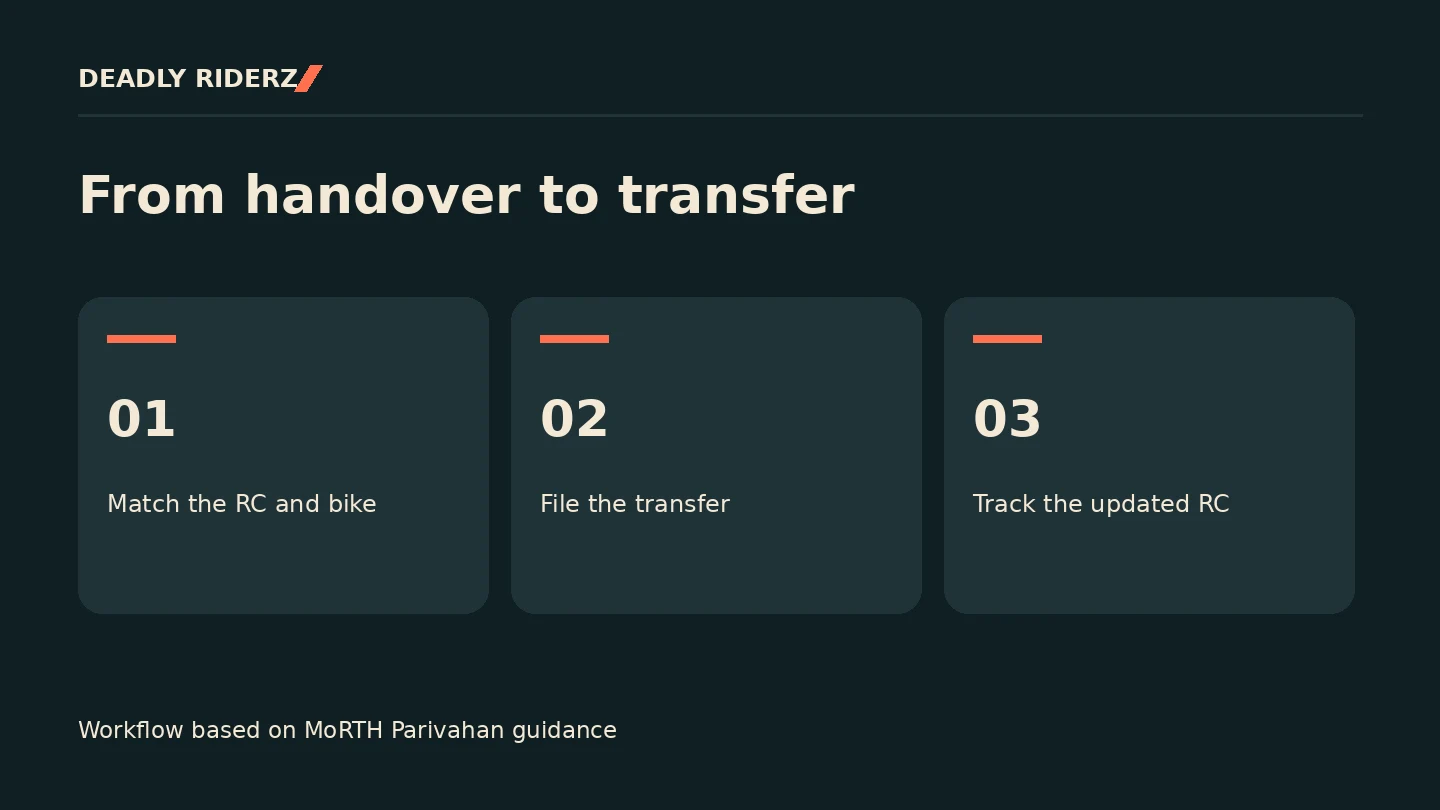
Ask to see the RC before arranging payment. Compare the registration number and identifying details with the bike, and confirm the seller’s name against the record. An intermediary may be perfectly legitimate. Ask how the registered owner will participate before you treat the intermediary’s assurance as a completed step. If the sale is through a used-bike dealer, establish which party is responsible for each document and who you should call if the registering authority asks for a correction.
Use the government’s Parivahan transfer guidance to work out what type of transfer this actually is. It describes the normal sale process as well as different routes for a vehicle inherited after a death or purchased at a public auction. This checklist follows a normal sale. Start with a different government checklist if your purchase falls into one of the other routes.
Tackle lender, insurance and state questions early
Ask whether the bike was financed and check the RC for a lender entry. If the seller says the loan has been settled, ask for the relevant lender paperwork and check the status with the registering authority. A screenshot of a paid instalment rarely answers whether the lender entry has been removed or which supporting documents the authority will request. Agree who will obtain anything that is missing.
Ask the insurer about the process and timing to transfer or arrange cover in your name. Give it the bike’s registration details directly and request confirmation. An in-force document that the seller shows you and confirmation of what is covered after handover are different checks. If the motorcycle is registered in another state, ask the relevant authority about the NOC and the receiving state’s process before promising a pickup date. The paperwork and fees can vary with circumstances and location.
Build a handover record that can survive a dispute
Write down the registration number, agreed amount, date and time of delivery, names of the parties, and what was handed over. List the keys, service records and accessories promised with the deal. Record who will submit each application and how they will share the acknowledgement. Keep the payment reference with the record. A dated, signed copy gives buyer and seller the same starting point if a document goes missing or the dealership handling the transfer changes staff.
Parivahan lists the original RC and insurance certificate among the documents for a normal transfer and says some further documents are requested in certain states. Its guidance lists a Form 30 application within 14 days for a vehicle registered in the same state and within 45 days for a vehicle registered outside the state. Treat the relevant deadline as a reason to plan ahead. Check your authority’s actual checklist and availability before the day you take possession.
Follow the application past the first receipt
The application reference is worth keeping, since it gives you a way to follow the transaction. Save it somewhere you can find without relying on the seller’s phone. Check the application status with the official service or registering authority, respond promptly to document queries, and confirm that the updated RC shows the correct owner and vehicle details. If a dealer promised to handle the transfer, ask it for evidence at each step. You should be able to follow the status yourself even if someone else submitted the paperwork.
Make a small table for the documents
| Before payment | At handover | After handover |
|---|---|---|
| Confirm owner, finance entry and RTO needs | Sign the handover record and collect documents | Track the transfer and check the updated RC |
Keep photographs of documents in a private folder and share them through the channels required by the registering authority. Recording a checklist the day before collection makes it easier for you and the seller to see which parts are complete. If signatures or documents are still outstanding, agree how you will get them while both parties are present.
A mechanical inspection still has its place. Ask a trusted workshop to look at a used bike before you buy and see how the likely first expenses fit into your budget. Our Speed 400 petrol budget example illustrates how to price one recurring cost after the purchase. The simplest rule at the handover is to make each open question belong to a named person with a date. Then follow through until the record itself tells you the transfer is complete.


