

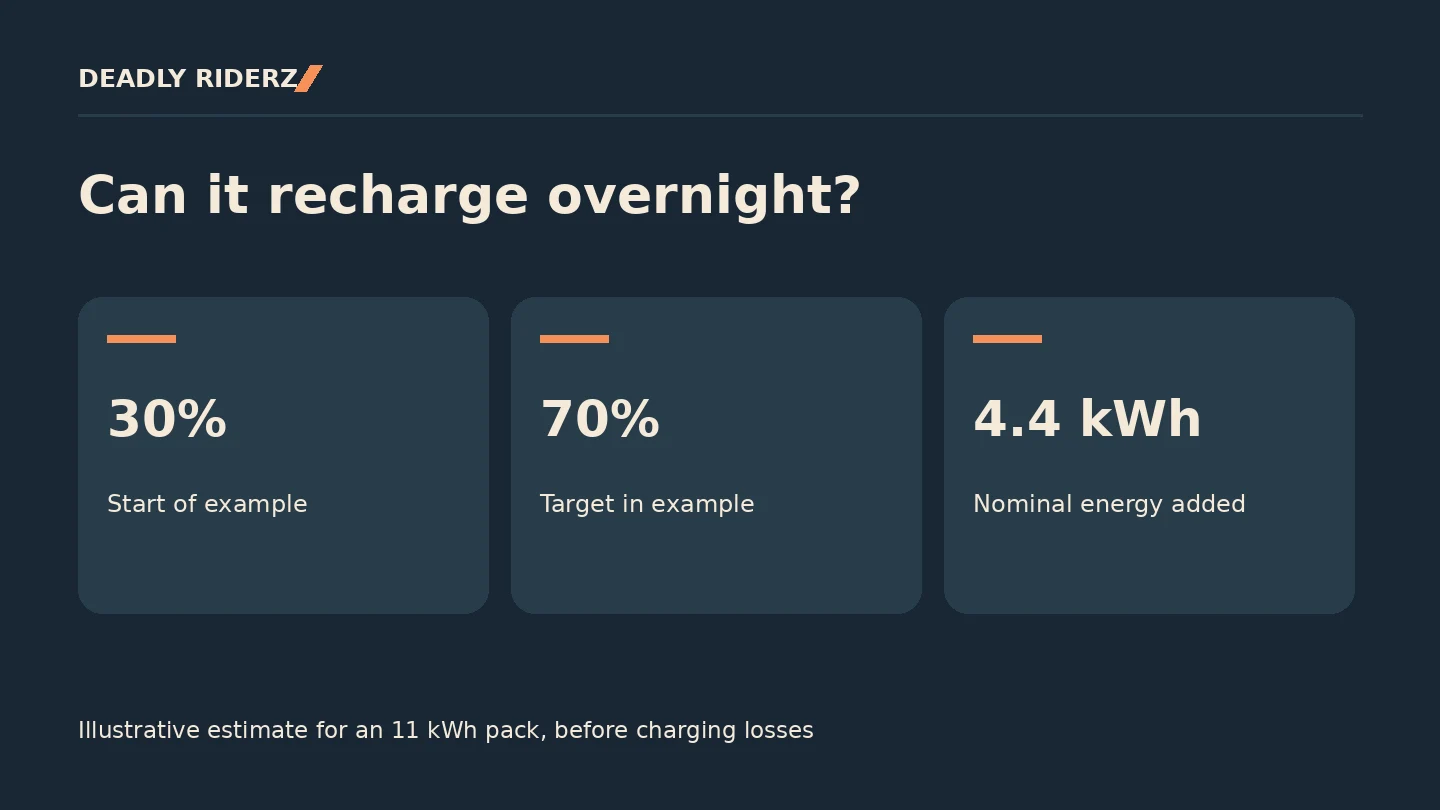
The number that matters to an electric motorcycle owner on a Tuesday night is often the number of hours the bike can spend in a charging bay. If you ride home with 30% remaining, want 70% in the morning and can plug in for the evening, how much energy does the bike need? Using the Ultraviolette X-47 Venom’s 11 kWh battery as a working example, that 40 percentage-point change corresponds to about 4.4 kWh of nominal battery energy. What happens next depends on the charger, the supply and the way the bike manages charging.
Highlights
- Ultraviolette lists an 11 kWh pack for the X-47 Venom on its product page.
- An illustrative 30% to 70% top-up represents about 4.4 kWh of nominal battery energy, before charging losses.
- Confirm the supplied charger, parking permission and actual usable charging hours before judging whether home charging fits your routine.
Begin with the Venom details for your order
Ultraviolette’s Venom product page describes the 11 kWh pack. The same site also shows other X-47 variants further down, so use the exact model and charger written on your quote. BikeWale’s launch report also identifies the 11 kWh pack and reported the planned November delivery start. Ask the dealer whether your order includes the charger setup being demonstrated and request its local input and output specifications. Delivery plans and actual stock are separate questions.
Work backwards from your morning
Multiply the nominal battery size by the change in charge level expressed as a fraction. For example, 11 times 0.40 gives 4.4 kWh. Suppose the average effective power reaching the battery was 1.0 kW for that interval. The simple estimate comes out to 4.4 hours. At 1.5 kW effective average, it comes out to just under three hours. Both power figures are hypothetical examples. Ask the dealer for the expected time in your configuration and at the charge levels you use.
The energy your meter records will depend on losses and any other power the bike uses while charging. The display’s relationship to nominal pack energy is also approximate. A measured weekday charge at your own parking bay gives a more useful household number than dividing a claimed full-cycle range by the battery size. If metering is available, record starting state of charge, final state of charge, time connected and kWh billed across several ordinary weeks.
Can your building support that routine?
Ask the building manager whether the bike can use the same spot every night and what billing arrangement applies. Give a qualified electrician the charger’s documentation and check the recommended electrical setup with the manufacturer. Ask the dealer to show where the connector goes and how the cable routes with the bike parked. A charger you can use for six hours at home solves a different problem from one you must move after a one-hour slot.
Consider access as well. Can you reach the bike after a late shift, and can you leave it there when rain changes the parking arrangement? If you share a bay, confirm which days you can use it and work from that smaller number. Keep the public charger you might use as backup in a separate column, with a realistic estimate of travel time and operating hours. That shows how often you would actually need it if home charging fell through.
What the electricity bill might look like
Say metering for one evening shows 5 kWh drawn and the rate that applies to your parking bay is ₹9/kWh. That session costs ₹45 under those assumptions. The tariff is an example. If a building uses a separate per-session or monthly charge, put that into the calculation. Our electric and petrol running-cost comparison sets out the broader cost categories to add when you compare the complete purchase.
How to read the worked examples
| Example average into pack | Energy to add | Idealized time |
|---|---|---|
| 1.0 kW | 4.4 kWh | 4 h 24 min |
| 1.5 kW | 4.4 kWh | 2 h 56 min |
Effective power is the average entering the battery over the chosen interval in this illustration. The bike can draw a different amount at the wall, and charging behaviour can change at higher displayed charge levels. Ask the dealer to show the time window for the actual charger and starting percentage you expect. If your building charges you on a fixed session fee, do a second calculation using that fee and the number of sessions you will actually need. A weekday example and a weekend recovery example can lead to different answers.
To decide, write down two recent weekday distances and a weekend trip, then work from the charging windows you can count on. Speak to the dealer if your only guaranteed window is short. Ask it to demonstrate a top-up from a starting percentage like the one you expect to see. This test is more likely to answer your overnight question than a biggest-range claim, because the output you want is a bike ready to leave on Monday morning.
ZigWheels shows where the onboard charger sits on an earlier X-47. Use it to see the charging layout, then confirm the included charger for the Venom with your dealer. Watch on YouTube.


