

A service estimate that says only “chain loose” gives a Hunter 350 owner very little to compare at the next visit. Ask for the measured movement, where it was measured and how the motorcycle was supported. Those three details turn a vague description into something another technician can reproduce. They also help distinguish a chain that needs adjustment from one that needs a closer inspection for wear.
Highlights
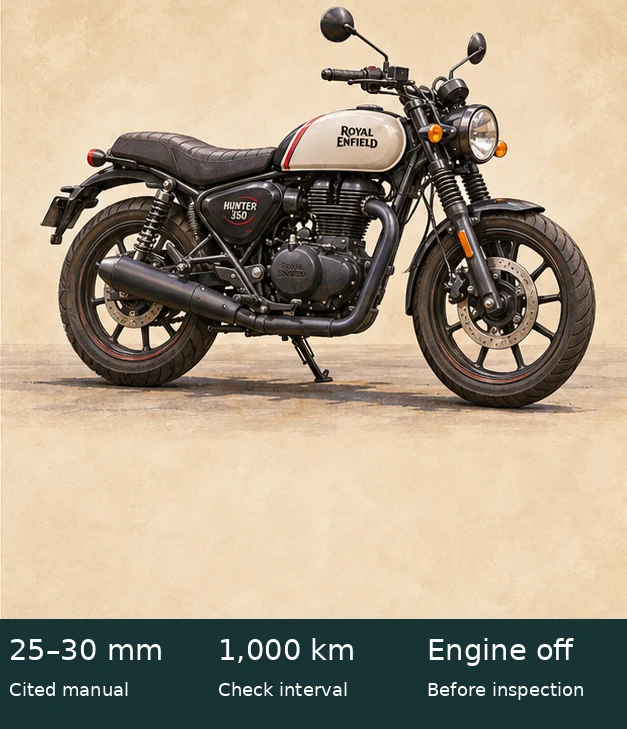
- Royal Enfield’s cited Indian Hunter 350 manual specifies 25–30 mm of chain slack and a check at 1,000 km intervals.
- Follow the illustration and support position in the manual supplied for your own version.
- Record the range of measurements around the chain and any stiff links or unusual noise for the workshop.
Find the right page
Use the manual that matches the model and variant on the registration and service documents. Royal Enfield publishes separate Hunter manuals, including single-channel and dual-channel ABS versions. The relevant section describes drive-chain maintenance and illustrates the span to check. Save that page on your phone so you can discuss the same reference at the workshop rather than comparing a number remembered from a different motorcycle.
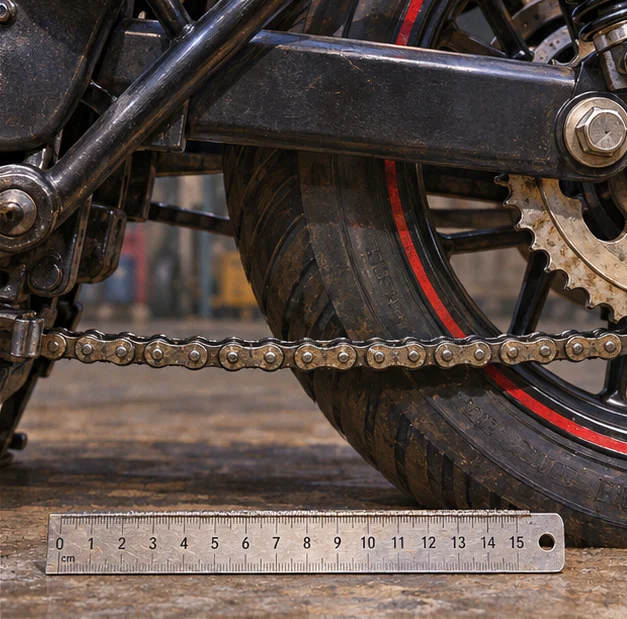
Slack is movement available in a particular span of chain under a defined setup. It is not the distance between the chain and the swingarm, a gap above the rear sprocket or how far one roller can be pulled away from a sprocket tooth. A ruler held at an arbitrary point can give a perfectly readable number that answers the wrong question. Find the measurement point and method in the drawing first.
Make a repeatable check
Work with the engine off, ignition off and the bike securely supported in the position the manual specifies. Keep fingers, loose clothing and tools away from the sprockets. Never run the engine in gear to move the chain for inspection. If you lack a stable place to support the bike, ask the workshop to demonstrate the check at the service counter instead of attempting it on a slope.
Use the same reference point for the two ends of the movement. As a simple reading exercise, if that point on a ruler reads 38 mm at one extreme and 65 mm at the other, the movement is 27 mm. The values 38 and 65 have no independent significance. It is their difference, taken at the correct position with consistent technique, that you compare to the specification.
Look for variation
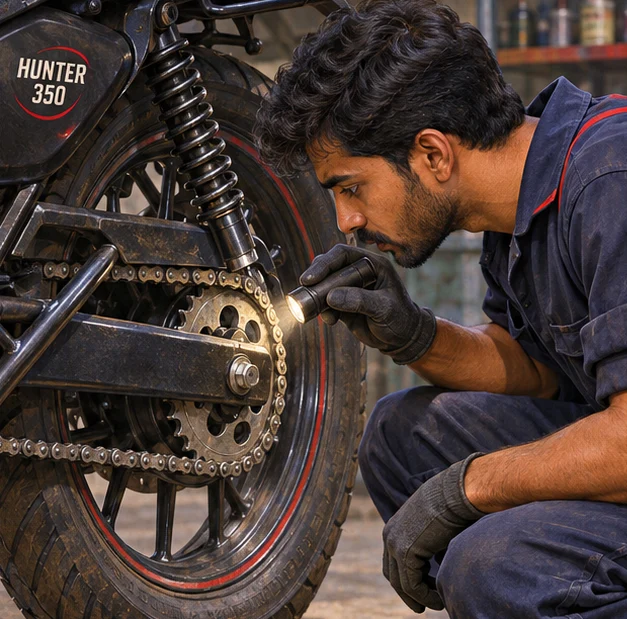
A chain can feel different at different positions as it moves around the sprockets. Have the technician show you how to check several positions safely. Record the tightest and loosest readings under the same conditions. If one part looks acceptable while another has conspicuously different movement or a link stays kinked, ask about chain condition before authorising an adjustment based on a single reading.
Consider a hypothetical workshop conversation. A first reading gives 28 mm while another gives substantially more. Simply tightening until the looser position reads 28 mm could leave the tighter section with insufficient movement. The important observation is the variation around the complete chain. It prompts inspection of the chain and sprockets together. It does not, by itself, identify the worn part or justify ordering a kit from a photograph.
Ask what the service includes
Routine cleaning, lubrication, slack adjustment and replacement are four different operations. A clean, lubricated chain can still be adjusted incorrectly. An adjustment cannot restore worn rollers or damaged sprocket teeth. When presented with a quote for a replacement set, ask the technician to point out the wear, damage or service-limit finding and record the explanation on the job card.
An adjustment also involves the rear wheel assembly. Royal Enfield’s instructions call attention to alignment and the matching adjuster markings. If the rear wheel was removed for a tyre job shortly before the motorcycle started behaving differently, mention that history. Let a qualified technician verify alignment, fasteners and the final slack to the specification for your bike. Guessing axle torque from another Royal Enfield model is a poor shortcut.
Keep a useful ownership record
Write the odometer, date, measured movement and relevant conditions on the invoice or in your maintenance log. A short note such as “checked after rear tyre replacement” is more useful months later than a photograph of a shiny chain. Keep the bill for any new parts and record whether the sprockets were replaced as well. That gives the next technician context if a noise or uneven spot returns unusually quickly.
A commuter doing 40 km on each of 25 working days covers 1,000 km in roughly a working month before weekend rides. Someone using the Hunter for Sunday outings will reach the same mileage far more slowly. Use the distance and the other inspection guidance in your own manual, with extra attention after unusual exposure or symptoms. If a chain appears damaged or insecure, get professional help before continuing to ride. A useful chain check ends with evidence and a clear service decision, not simply a tighter chain.
Watch the details
Royal Enfield demonstrates cleaning and lubrication on the Classic 350. Use the Hunter-specific manual for measurement and adjustment.
Sources and further reading
Royal Enfield Hunter single-channel manual
Royal Enfield Hunter dual-channel manual
Royal Enfield Hunter 350 fit check: What 790 mm won’t tell you
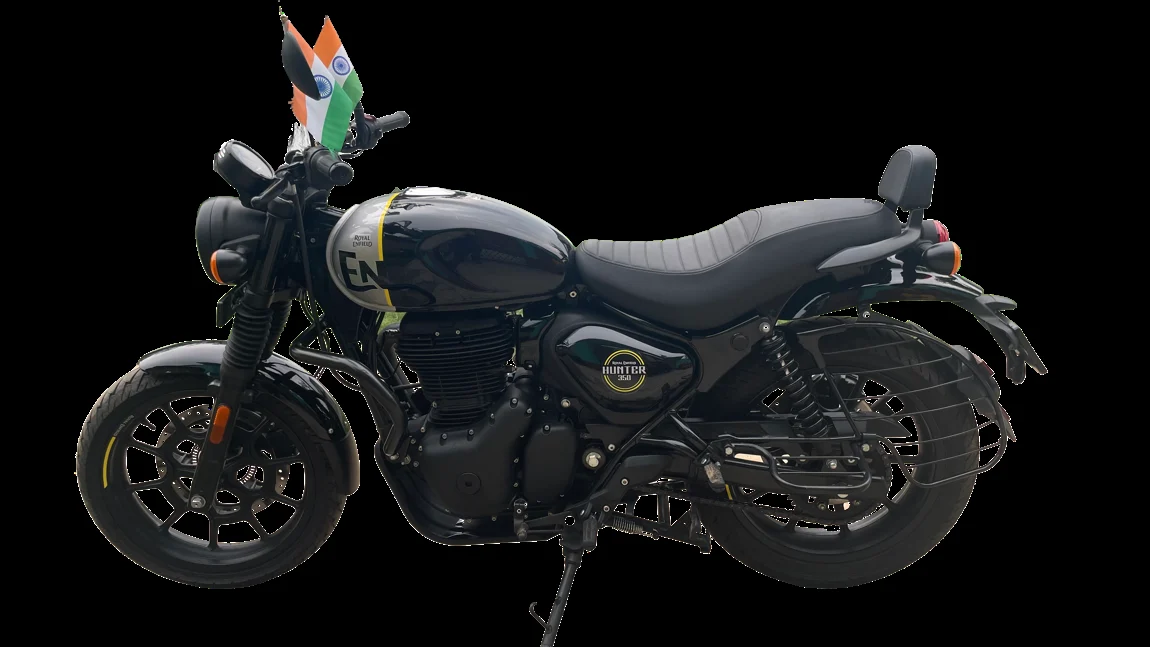
Reference photo: Pintu dasaundhi, CC BY-SA 4.0.
Featured image: Deadly Riderz editorial illustration.


