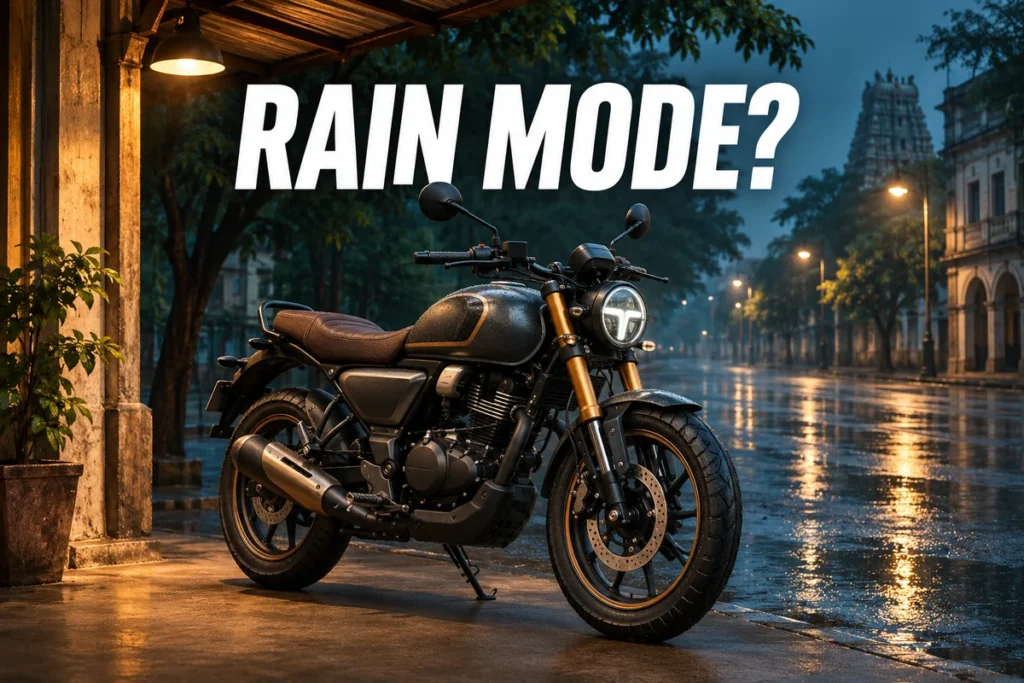

If you select Rain on a TVS Ronin that supports the feature, the important change described in the owner’s manual is how early the anti-lock braking system intervenes when it detects a wheel is tending to lock. TVS recommends Urban for routine city and highway riding and Rain for wet or muddy surfaces. The setting is not a second tyre compound, an instruction to ride faster in the wet or a promise that the bike will stop in fewer metres. Think of it as a choice of how the brakes are managed when grip is scarce.
Highlights
- Rain and Urban are described by TVS in terms of ABS behaviour; don’t assume a reduced engine power mode.
- The button request and the active dash indication are separate. TVS says the change takes effect once the throttle is closed.
- Before buying, match the owner’s manual to the actual bike and have the dealer demonstrate the active modes.
What changes in Rain mode?
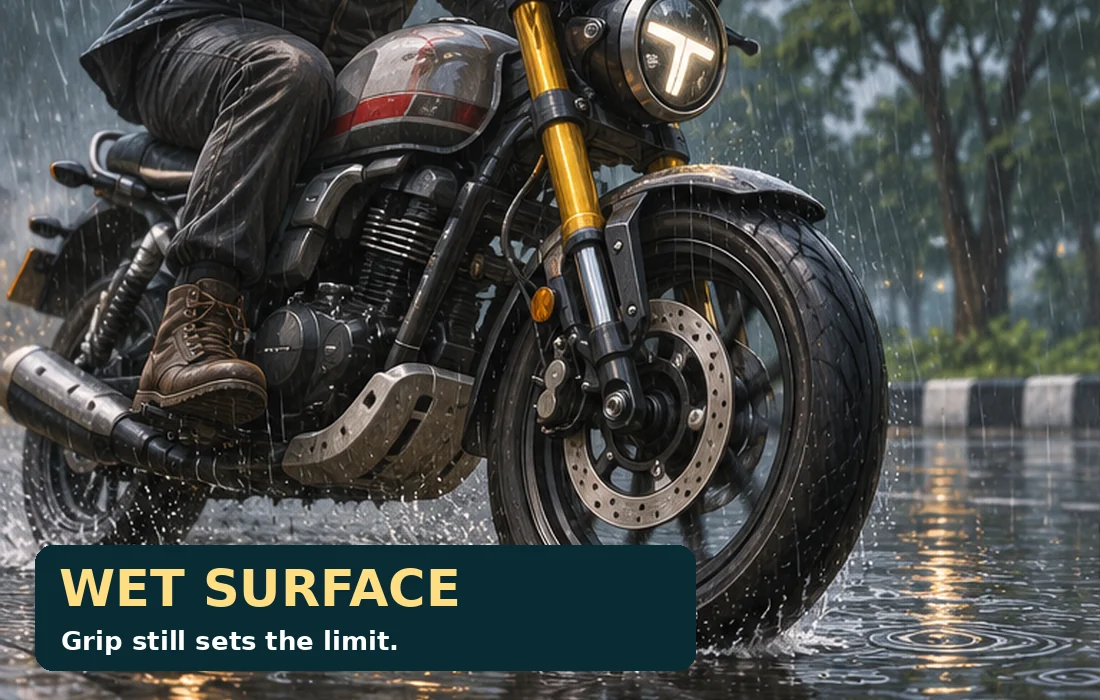
During an ordinary gentle stop, the brakes can work normally without ABS needing to step in. If a wheel begins to slow too quickly, ABS can modulate brake pressure to help prevent a lock. The TVS Ronin owner’s manual describes an earlier intervention in Rain. That does not mean there is a particular road speed where the mode starts working. The point is what happens when a wheel approaches a lock, not what the speedometer says as you ride steadily.
This matters on a patchy road. Imagine approaching a signal where most of the lane is merely damp but the painted lines and the repaired strip near the stop are slicker. A mode can change how the brake system responds to a lock tendency; it cannot change the surface, the tyres or the room you had before you started slowing. Put the effort into planning the stop earlier, leaving more space and avoiding sudden steering or brake inputs instead of looking for a sensation at the lever.
Why the dash still says Urban
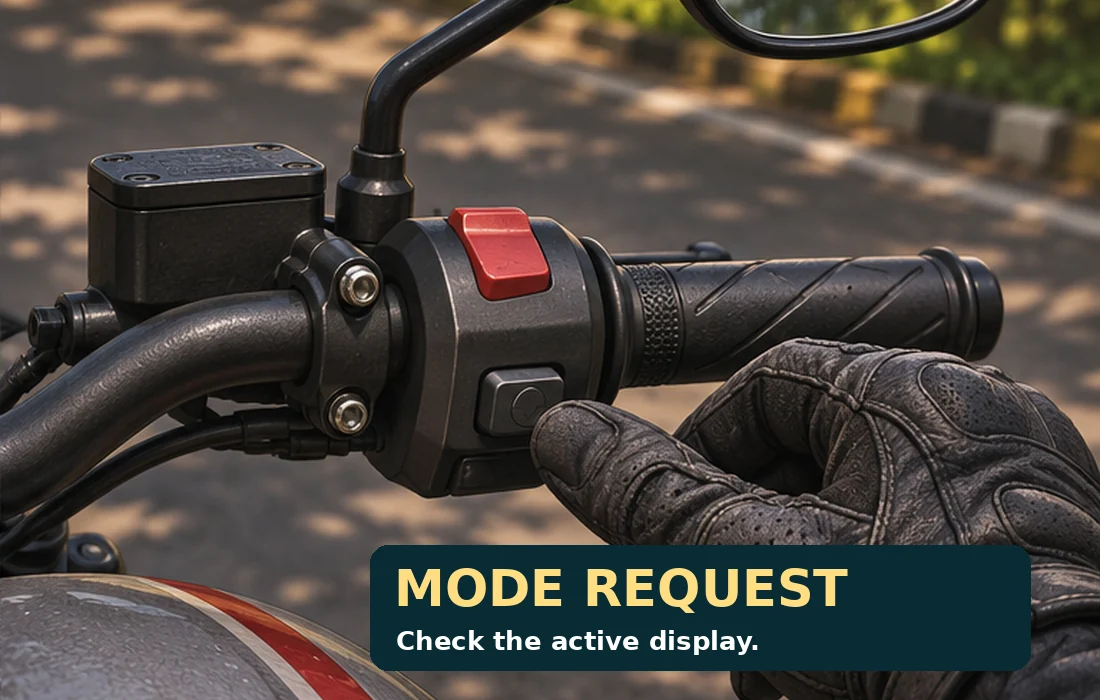
Separate three things: pressing the mode control, meeting the condition for the change, and seeing the new setting become active. The handbook explains that the throttle needs to be closed after a request. Depending on the cluster, a message or a shortened prompt can appear while the change is waiting. The currently active mode is the confirmation to look for. If you’re new to the controls, ask your dealer to show the sequence while safely stationary rather than reading a display in moving traffic.
A bike that shows the request but doesn’t change straight away isn’t by itself proof of an ABS fault. Check the procedure and the manual that matches your cluster. A repeated mode-change error or a brake-system warning that stays on beyond the handbook’s normal self-check is a different concern: contact a TVS-authorised workshop. Make a note of the displayed message and the conditions when it appeared. Don’t try to create a skid or an emergency stop to confirm the system yourself.
How to check a bike before paying
Ask the salesperson to identify the variant and model year on the actual quote, then show the control and the active mode on that same bike. Product literature may cover several versions, and a walkaround of a connected display doesn’t establish what a lower trim or used motorcycle has. The terms single-channel and dual-channel refer to which wheels the ABS system manages. Mode names refer to its settings. Do not assume that a rear disc or a dash styled like the demo bike proves both sets of features.
For a new bike check that the showroom demo and allocated unit match. For a used Ronin check the handbook alongside the registration and ask the seller to demonstrate the setting without any high-risk braking. Confirm what is standard, what belongs to another variant, and what is working on the unit in front of you. The Ronin trim buying guide covers the wider choice; the mode check is one part of it, not the whole reason to pay for a different trim.
A useful way to choose
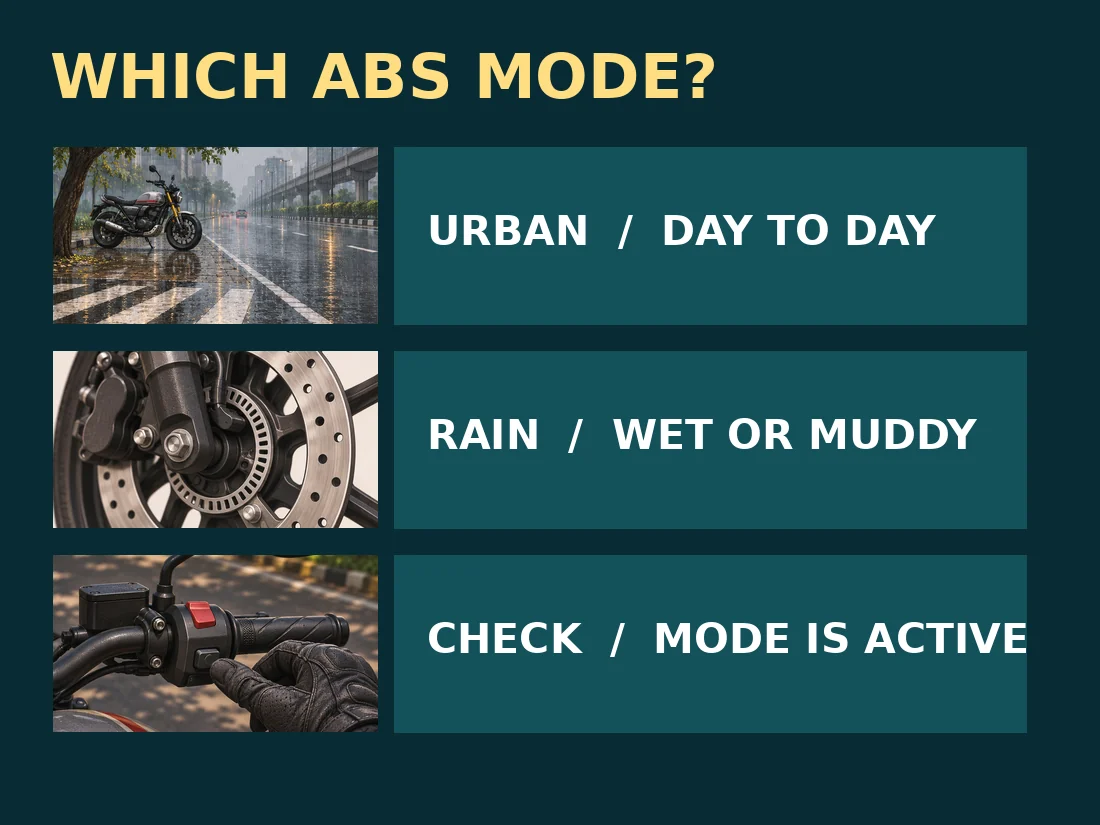
Dry commute and ordinary mixed city traffic? Urban is the handbook’s everyday recommendation. Going out in widespread rain? Where your bike offers it, choose Rain before the moving part of the ride and make sure the display agrees. If the road turns slick halfway home and you’re unsure which mode is active, focus on speed, space and observation first. Stop somewhere safe before taking your attention from the road to the controls. Neither mode makes a deep pool, wet metal or loose gravel safe at your usual pace.
TVS’s video demonstrates the modes on a dual-channel ABS-equipped Ronin. It’s a useful orientation to the feature, not a measured comparison of stopping distances, and does not establish that every Ronin includes it. For your bike, the matching handbook and an on-bike demonstration are better evidence than the dash on someone else’s video.
Watch the manufacturer video on YouTube.
Bottom line: choose the mode for the road surface and look for the active setting, not just a button press. If you are shopping, verify that the exact unit has the equipment you want. The feature can support controlled braking, but your speed and the space you leave matter before either mode does.


