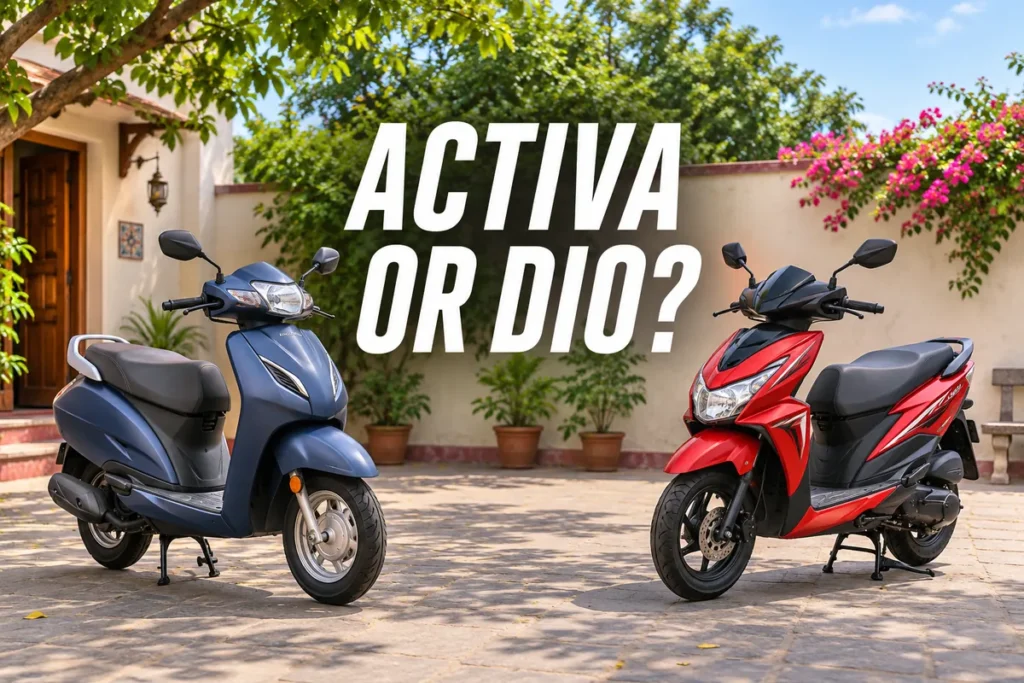

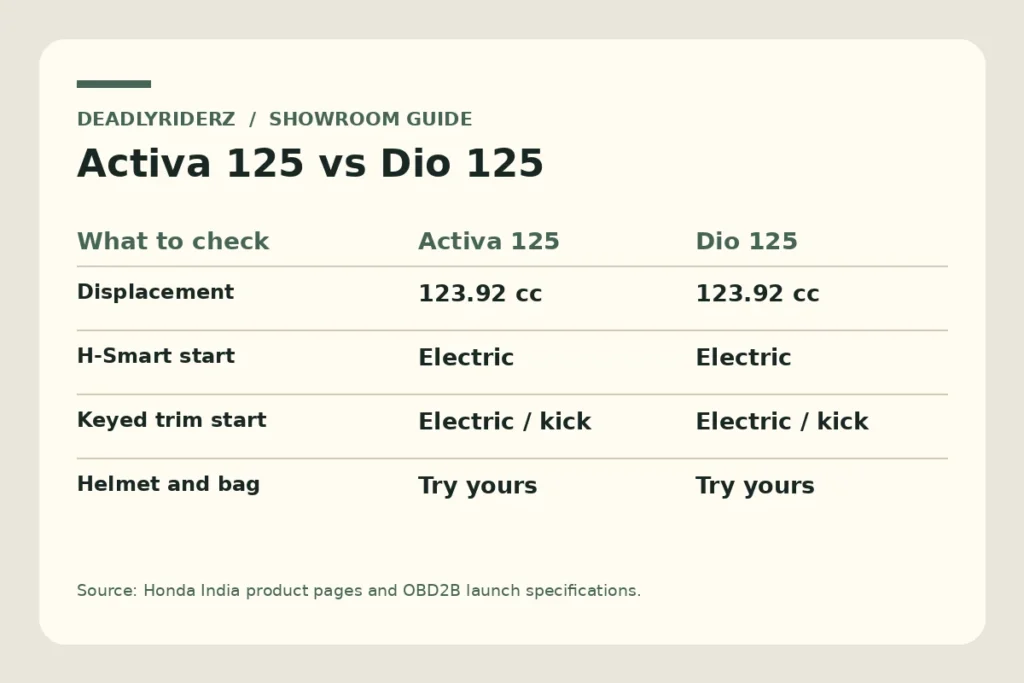
Pick the Honda Activa 125 or Dio 125 after trying your own helmet and bag on the exact scooter you would buy. Their OBD2B models share a 123.92 cc displacement, so the difference you notice on a daily ride may be how comfortably the scooter fits you, where your things go and whether you want a kick-start lever.
The differences worth asking about
Honda’s current Activa 125 listing shows DLX with a conventional key and self/kick starting; H-Smart uses a remote key and electric starting only. The Dio 125 product page shows a similar split but calls its conventional-key model STD, versus DLX in the earlier OBD2B launch release. That’s a good reason to read the dealer’s exact trim name instead of transferring a feature from one brochure to another.
The Activa page highlights an open glove box and a 15W USB-C port. The Dio page lists a front pocket, double-lid external fuel fill and retractable pillion footrests, and its own trim matrix lists Bluetooth and navigation on H-Smart, not the STD. Check that your quote names the display and phone connectivity you tried, rather than paying for a vague “smart” package. This guide compares the regular scooter listings, not a special edition or the Activa 110.
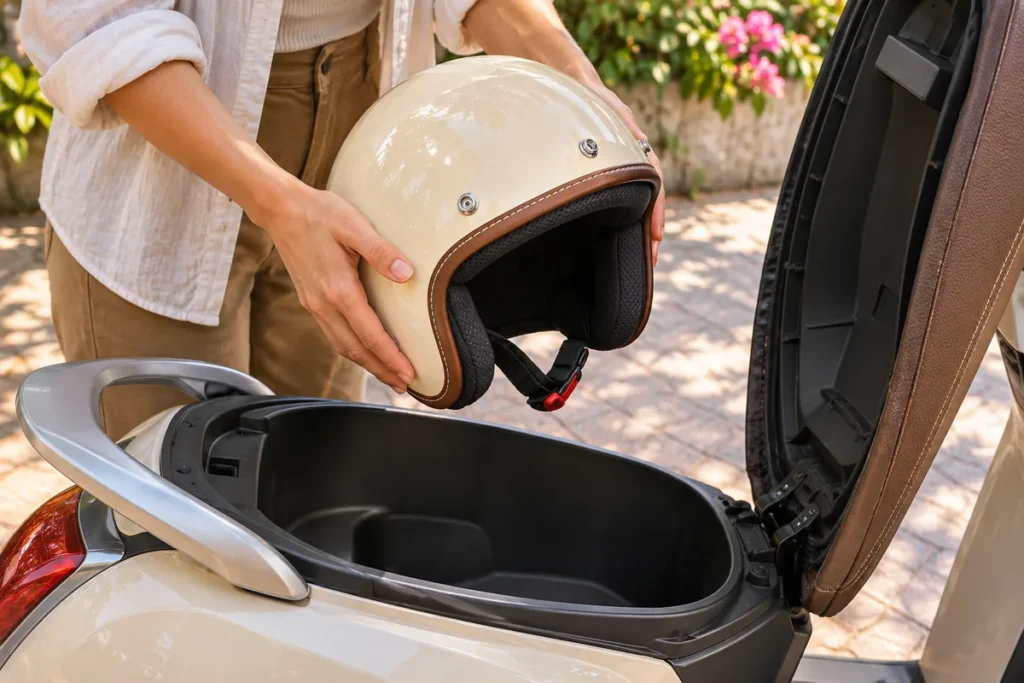
Bring one helmet and the bag you actually carry
With permission, open the under-seat bay and lower your helmet in the orientation you would naturally use. Check whether the rim, visor, or a Bluetooth intercom gets caught on the opening. The seat should latch gently with clearance. If the helmet presses against the seat or you have to take off an intercom every day, call that a failed fit. There’s no universal helmet-size guarantee in this comparison; shell shape is more useful than a claimed litre figure.
Try your everyday bag with the scooter stationary. Check that it doesn’t crowd your feet or contact the handlebars. Never plan to ride with an unsecured bag on the footboard or on the handlebar. If the pocket will mainly hold a phone or garage remote, check how exposed it is, how the USB cable routes, and where you can stow the items when parking. Think about the full trip: a scooter can pass the bag test but still leave nowhere to put the helmet once you arrive.
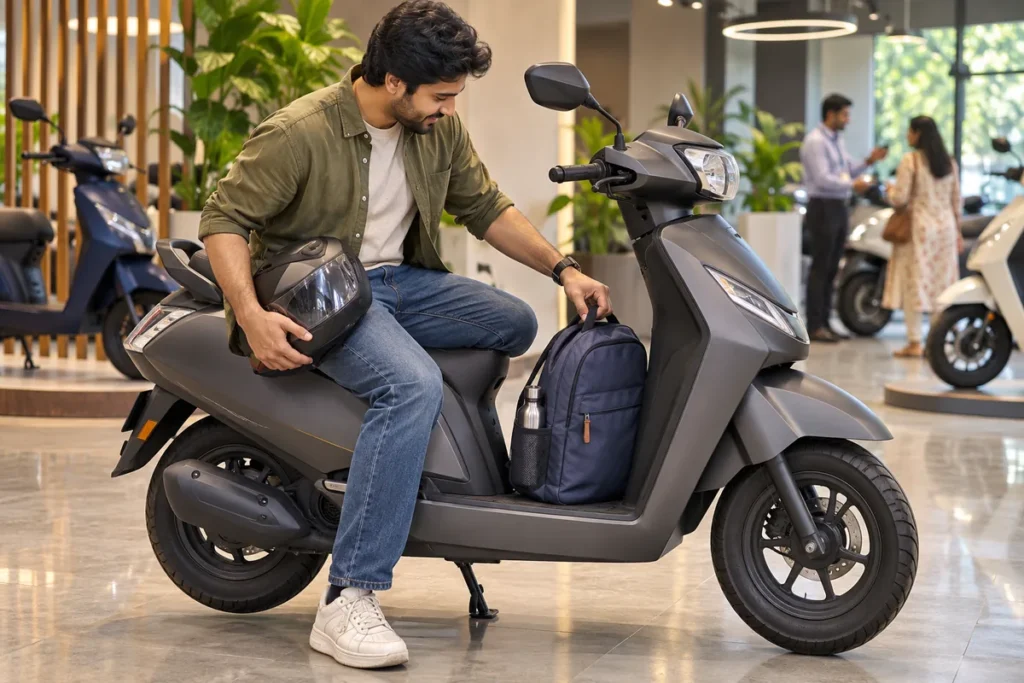
Driveway and pillion check before a test ride
Wear your normal riding shoes and sit with the bars straight. Notice whether the nose of the seat makes you spread your knees. With the dealer watching, move the scooter on level ground with the engine off. A comfortable standstill and a small forward-and-back parking move tell you more about your driveway routine than seating photos. Don’t try to recreate an incline in a busy showroom.
If you often carry a passenger, bring that person to the showroom. Ask them to try the footrests and grab points with the scooter supported, then check where your own feet sit with a passenger on board. During a dealer-approved test ride, pay attention to low-speed steering, mirrors, brake-lever reach and whether you can see the main display in daylight. Try both scooters on the same short route rather than treating a longer ride on one as a fair comparison.
What to put on the written quote
Ask for a dated quote with the full trim name, model year, key type, confirmation of kick-start if you want it, and a line for each accessory. Keep the on-road total separate from the ex-showroom figure and do not assume a navigation app, spare fob or charger is included just because it appeared in an advertisement. Ask the salesperson to use the actual scooter to show how to unlock the seat and fuel filler if the fob battery is exhausted, with reference to the owner’s manual.
If both scooters pass the fit checks, buy the one that gives you the key and starting setup you prefer at the better written price. If only one works with your helmet and normal parking space, that is a stronger reason to choose it than a slightly different feature list. Shopping across brands too? Our Access 125 trim comparison shows what Suzuki’s two ABS options add in Indore.
Sources: Honda India’s Activa 125 and Dio 125 OBD2B announcements, alongside the model pages. Visuals are DeadlyRiderz illustrations, not Honda product photos.
Watch the manufacturer’s overview
Honda India’s video includes both the Activa 125 and 110. Use it for an introduction, not to identify what every 125 trim includes.


Pingback: Chetak C35 Boot Space: Helmet Fit Across 3 Trims