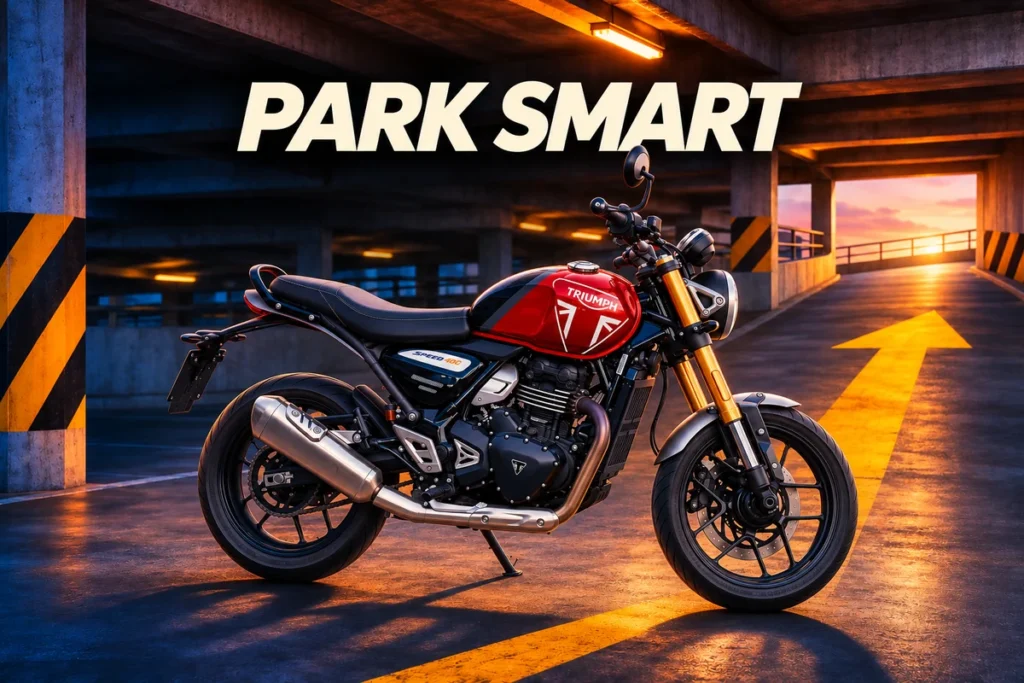

If you can stop your Triumph Speed 400 confidently but struggle to push it backward, that does not automatically mean the bike is too tall. At a stop you need enough footing to hold the bike steady. Reversing needs grip, room to take a step and enough reach to generate a push. A ramp or a sloping parking bay can take away all three at once. Start by changing how you park, not by buying a lower seat.
Highlights
- Park so you can ride out forward whenever you have a choice. Avoid a bay that requires an uphill push to leave.
- The original India Speed 400 was quoted at 790 mm and 170 kg wet; some later Triumph India listings are 803 mm.
- Test any change in riding boots on clean, level ground before paying for a seat.
Why your heels matter more when you move
Picture a rider who can place the balls of both feet on the floor while seated. Standing still, that contact can be enough to hold the motorcycle upright. To move it backward, the rider has to lift one foot, find a fresh patch of ground and move the bike before bringing that foot down again. When your stride is already short, each push buys very little movement. The weight of the bike has not changed, but what your feet can do has.
Now add a shallow ramp or a road that slopes toward the gutter. On an uphill reverse, you have to move the machine against gravity. If the surface also tilts sideways, one foot has farther to reach. Wet tiles, loose sand and a raised parking stop can make the same bike feel much harder to manage. This is why the showroom test on a flat floor and the test at an apartment parking bay can give different answers.
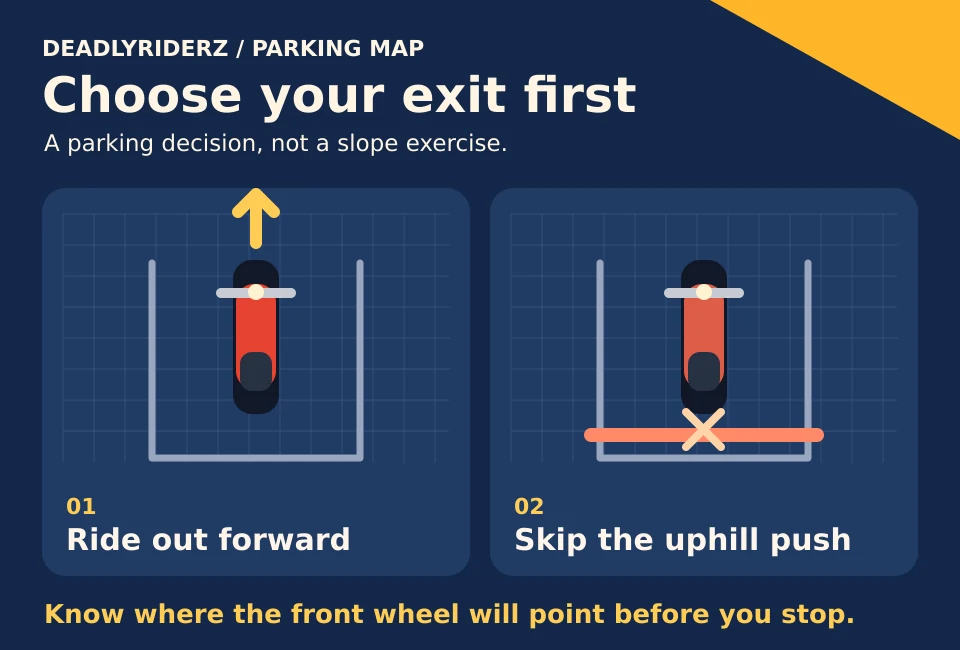
Pick the parking space by its exit
Before you stop, ask: Which way will the front wheel point when I leave? Look at the slope both along the bay and across it. At home, it may be easier to use a level bay or align the motorcycle on the flat before entering the space, rather than pushing uphill when you leave. At a fuel pump, use a lane you can continue through. On a trip, look past the most convenient entrance for a firm, level spot with a clear way out.
In the Triumph India owner’s handbook, locate the parking section for your bike. It advises stable parking, first gear after positioning, and facing uphill when parking on a hill. Choose level ground where possible. The advice on securing a stationary motorcycle is not an instruction to attempt a reverse on a steep ramp. If footing or braking control feels doubtful, use another bay or get help while the bike is stationary. Avoid improvising on a crowded or slick slope.
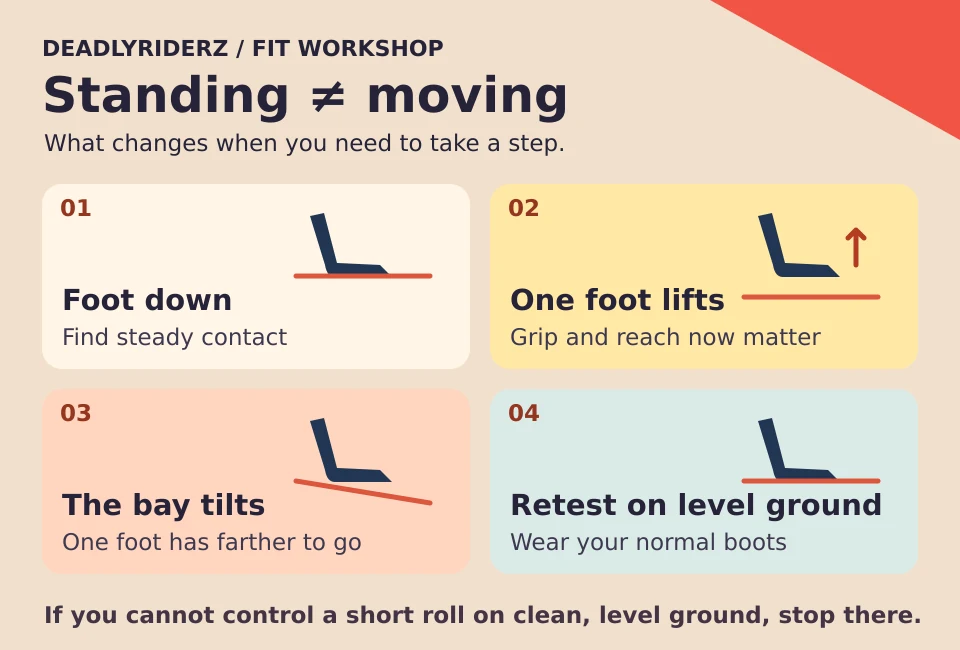
Do a five-minute fit check before changing the seat
Use clean, level ground away from traffic, normal riding boots, and preferably an instructor or an experienced spotter. Stop and settle the bike before doing anything else. Check whether you can get a dependable foot down, whether your boots grip the surface and whether a very short reposition feels controlled. If you cannot manage it without straining or leaning into somebody else’s space, stop there. Recognising that limit is a useful result.
Where you sit also matters. Seat height is one vertical number, but a broad seat can make your legs travel farther outward before they reach the ground. A softer seat may compress when you sit but still feel wide around the front. In a supervised check, try the normal forward part of the seat and confirm you still reach the bars and all controls without stretching. Keep a stable posture rather than chasing both heels on the ground.
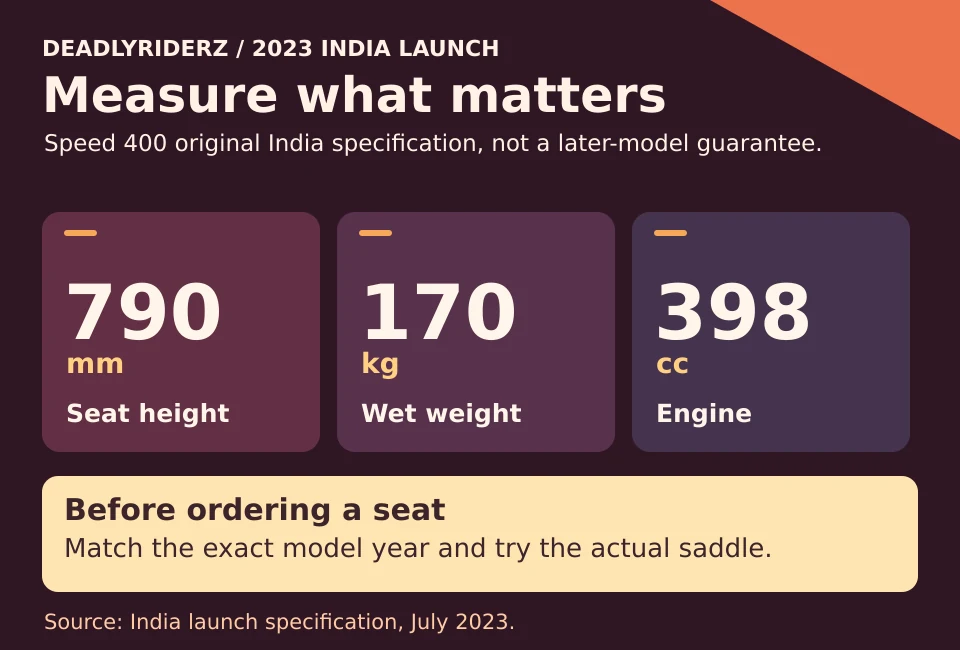
What a lower seat could fix, and what it cannot
A correctly fitting lower or narrower seat may give your boots more solid contact. It won’t reduce the weight you need to move or flatten your driveway. If the issue happens only on one ramp, parking direction is usually the first change to try. If even level-floor starts and stops feel awkward, ask the dealer to confirm a compatible saddle by VIN and let you sit on that exact option in your normal gear.
For the first-generation bike, Bajaj’s India launch specification lists 398 cc, a 790 mm seat and 170 kg. Triumph India’s later 398 cc listing quotes 803 mm, which is why a search can show two different heights for bikes with the same name. Treat internet figures as a starting point, not enough information to order a seat or change suspension settings.
See the original bike’s proportions
Motoroids’s launch-era walkaround shows how the saddle meets the tank and gives a useful look at the bike’s shape. It is not a parking tutorial and its launch price is historical.
Open Motoroids’s Speed 400 walkaround on YouTube
The answer in one sentence
If your Speed 400 is controllable on level ground but awkward to reverse out of one sloping parking space, fix the exit before you fix the seat. For a separate question about running costs, see our Speed 400 mileage and engine-version guide.
Cover illustration based on a photo by Corvettec6r / Wikimedia Commons, CC BY 4.0. Adapted as an editorial illustration; the garage scene is not a photographed parking demonstration.


Pingback: Honda CB125 Hornet Fit Check: 124 kg, Seat Reach and Parking
Pingback: Triumph Speed 400 Pillion Preload and Payload Checks