

The Honda QC3’s charger can go upstairs. The battery stays with the scooter. That distinction decides whether the QC3 will work in an Indian apartment building long before a certified range figure becomes useful. If your allotted bay is two floors below your electricity meter, the first test is a walk from the parking space to the building office, with a picture of the bay and Honda’s charging instructions in hand.
Highlights
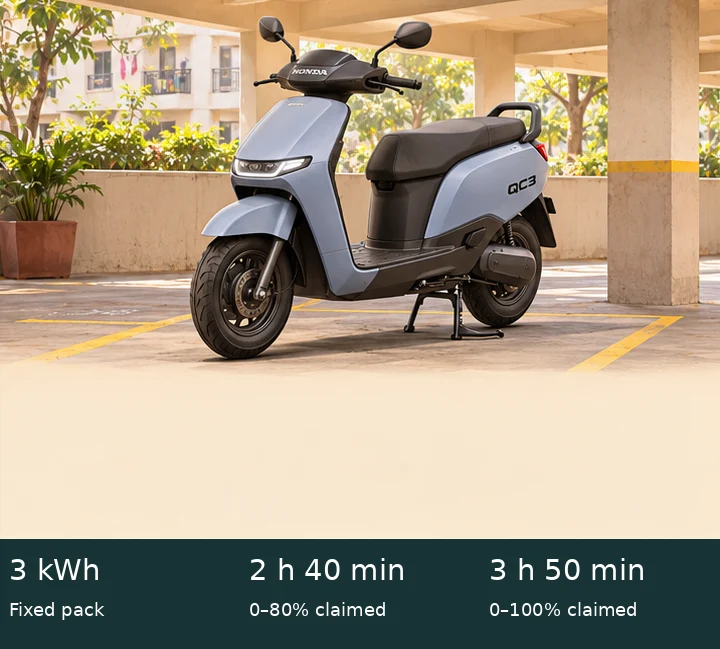
- Honda specifies a fixed 3 kWh battery arrangement and a portable off-board charger.
- Its current specification sheet claims 2 hours 40 minutes from zero to 80% and 3 hours 50 minutes for a full charge.
- The 950 W figure is charger output. A qualified professional needs the actual equipment requirements to assess the parking supply.
Start at the parking bay
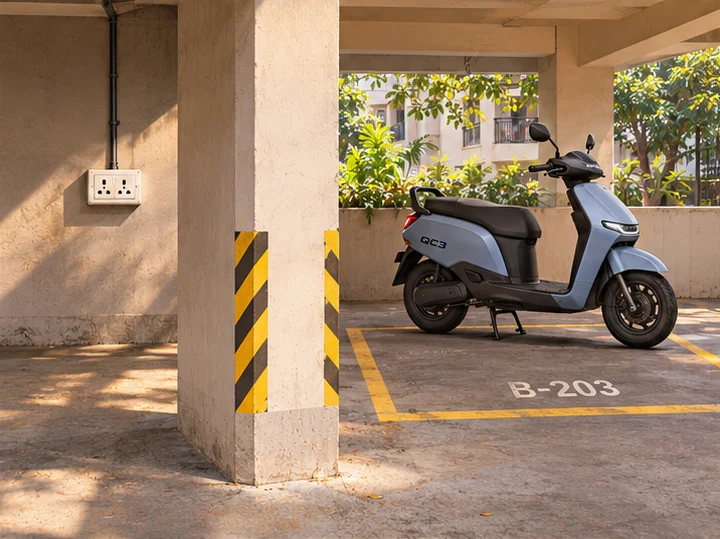
Stand where the scooter will actually spend the night. Which side can you approach when the neighbouring car is parked? Can the charger sit in the location Honda permits without obstructing another bay or a walkway? Who controls access when the building closes a service entrance? A socket visible on a pillar across the aisle answers none of these questions by itself. It might be part of a common-area circuit managed by the association.
Photograph the layout for the dealer and the building manager. Ask for the owner’s charging instructions for the Indian QC3 and the input label on the supplied charger. Have a qualified electrical professional assess the intended location against those instructions and local requirements. A salesperson describing the unit as portable gives you no basis for selecting a socket, an extension arrangement or a protective device. Avoid improvising a supply from an upper floor.

Separate permission from installation
An assigned parking bay gives you somewhere to leave the scooter. Ask who can approve electrical work, how electricity consumption would be measured and who would maintain any new installation. Get the answer in writing before a deposit depends on it. If you rent the flat, include the landlord as well as the association. Permission from one party may leave a second practical question unresolved.
Picture two owners in the same building. One has a professionally installed, approved charging point on their own meter. The other must book time at a shared bay and move the scooter afterwards. The product and battery are identical, but the second owner needs a timetable as much as a socket. Check whether overnight access is allowed and whether leaving the scooter after a session conflicts with the next resident’s booking.
Read the charging times correctly
Honda’s sheet lists a portable off-board unit rated at 950 W output. That rating describes the charger’s output side. It does not establish the electricity consumed at the wall for a particular session. Nor does multiplying that figure by a chosen number of hours produce a reliable home bill. Use the approved meter reading and the tariff that actually applies to your parking arrangement when estimating monthly cost.
The difference between Honda’s two published charge times is one hour and ten minutes. In the quoted zero-to-full sequence, that is the extra time from the 80% point to full. A two-hour booking at a shared bay therefore cannot be assumed to cover the entire claimed zero-to-80% session. Equally, an owner arriving with substantial charge remaining does not automatically need a full three hours and fifty minutes. Observe your own starting and ending levels once the setup is approved.
Put range into your working week
Honda’s latest sheet lists certified figures of 151 km in ECON and 144 km in STANDARD. These are certification results, not distance measurements from your road. A 20 km round trip on five working days adds up to 100 km before detours. A second rider using the scooter each evening for a six-kilometre errand turns that week into 130 km. The battery must accommodate the household’s use, not just the main commuter’s office route.
Allow room in the schedule for a late return or an unavailable charging bay. A buyer who reaches home at eight with a dedicated point has a very different margin from one competing for a two-hour session after dinner. If a regular workplace charger is part of the plan, confirm vehicle compatibility, access rights and opening hours there too. Build a backup around a point you can actually use.
Check support before reserving
At the September launch, BikeWale reported select RedWing dealerships in Delhi, Agra, Cuttack, Surat and Kollam as the initial sales locations. That is a dated launch list. For an Indore buyer, or anyone outside those cities, ask Honda to identify the outlet currently taking local orders and the workshop responsible for support. Get the answer for the QC3 specifically. A dealership selling petrol scooters nearby cannot by itself establish electric-model availability.
A useful booking file has three items: the dealer’s written confirmation of local supply and service, approval for the charging arrangement and a realistic weekly parking schedule. If all three fit, you can compare the QC3’s price and equipment against alternatives on equal terms. If the bay remains unresolved, put the purchase decision on hold. Carrying the charger home will never move the fixed battery closer to the electricity.
Watch the details
Honda 2 Wheelers India introduces the QC3. Look at the scooter’s layout alongside the parking-bay checklist.
Sources and further reading
Honda QC3 technical specification sheet
BikeWale’s 22 September launch report
Can the Ultraviolette X-47 Venom recharge overnight at your parking spot?
Featured image: Deadly Riderz editorial illustration.


Pingback: Ather Rizta storage: What fits in the 34 L boot and optional Frunk?
Pingback: VIDA VX2 removable battery: The apartment carry test before you buy