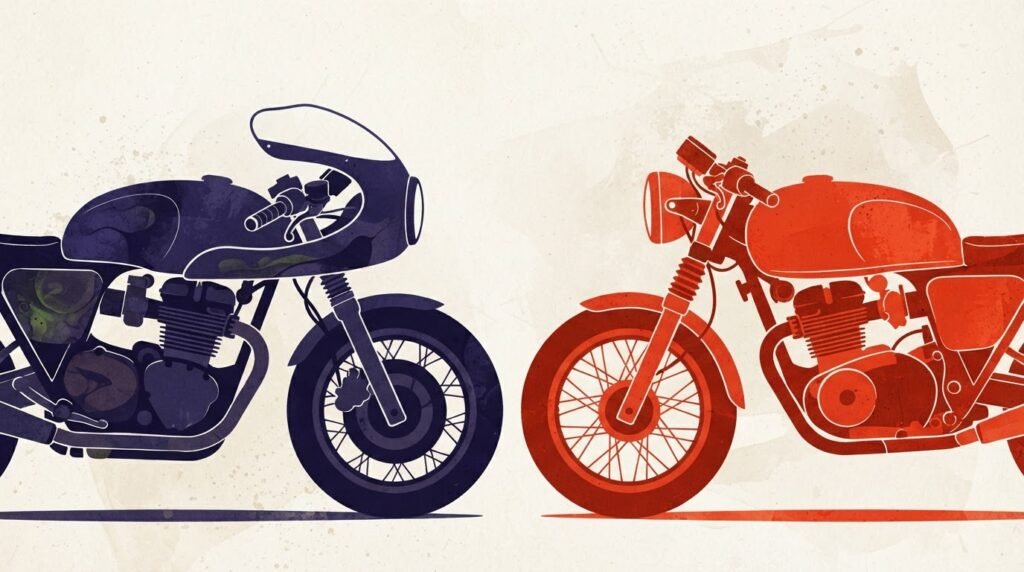

The TT Blue Continental GT 750 might sell you on the fairing before you’ve even sat on the bike. Give the chrome Master Clean a second look. Royal Enfield has put the bars lower on the faired bike, which means the choice you make with your eyes in the showroom is also a choice your wrists will feel on Monday morning.
Spot the difference from across the showroom
Start at the headlamp and follow the outline back to the tank. On the unfaired GT, the round lamp stands on its own. On the faired GT, the bodywork wraps around the nose like a period race bike. Then look past the paint at the front wheel. BikeWale identifies three distinct combinations on the EICMA show bikes:
| Show colour | Front end | Wheels shown |
|---|---|---|
| TT Blue | Faired, lower bars | Alloy |
| Red Line | Semi-faired, lower bars | Wire-spoke |
| Master Clean | Unfaired, exposed headlamp | Wire-spoke |
If you like the racer nose but want spokes, Red Line is the one to look for in the footage. If the front wheel is what caught your eye on TT Blue, changing the paint alone won’t recreate that look. BikeWale’s show-bike breakdown.
Watch the two details photos tend to flatten
In Autocar India’s EICMA walkaround, watch the GT from the side to see where the bars sit against the tank. From the front, look at how much of the fork and headlamp the fairing actually encloses. The video also covers the Flying Flea S6.
What the lower bars mean at a traffic light
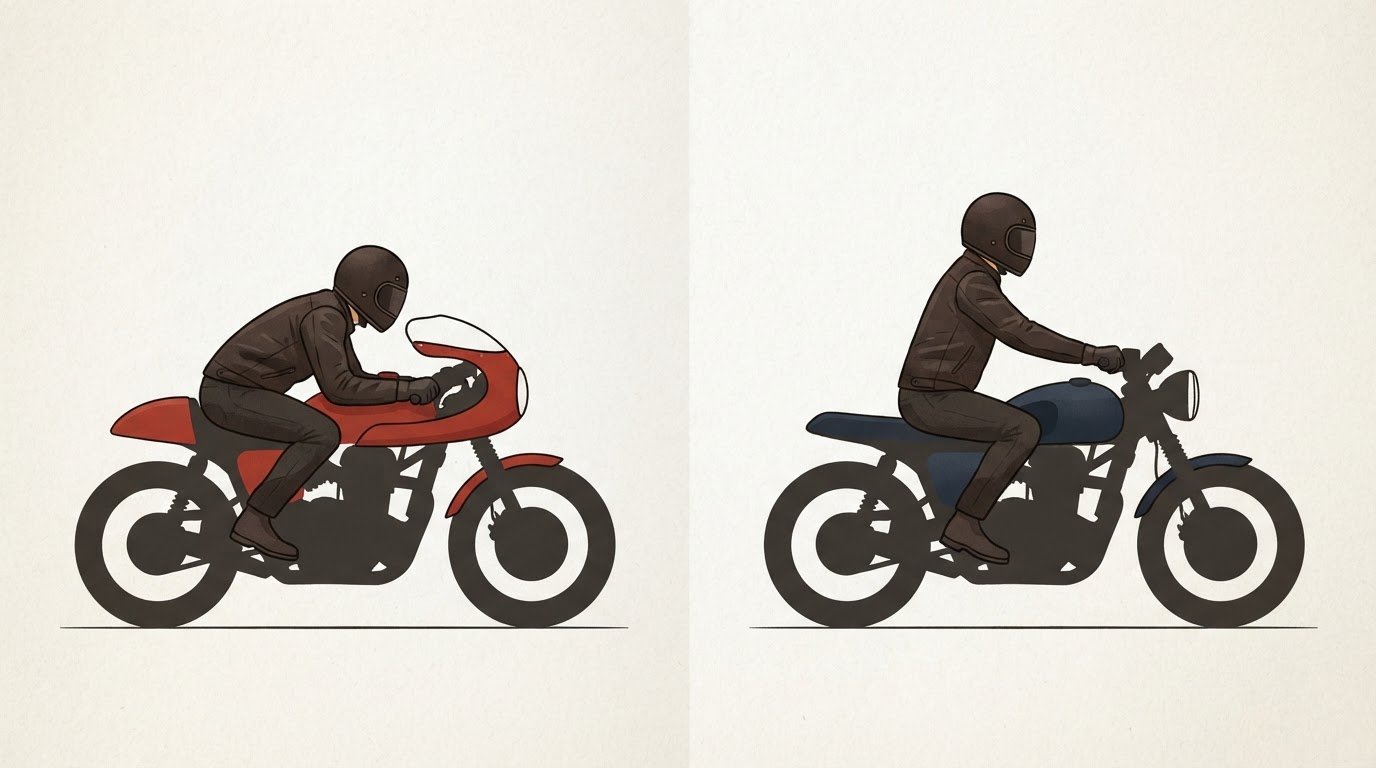
Picture the last two kilometres of your commute. You’re slowing for a junction, turning your head to check traffic and making a tight turn into your parking space. That sequence is a better showroom prompt than simply asking whether the GT is comfortable. Sit on both versions in your usual jacket. With the bike supported, turn the bars and see whether you can keep your elbows bent and your grip light without sliding towards the tank.
For weekend rides, add one more question: where does the air hit your helmet at your normal cruising speed? The fairing gives the bike a different profile, but a photograph can’t tell you whether the airflow will suit your height. That’s the part to save for a test ride.
743 cc is confirmed. What about power and price?
Royal Enfield calls the GT’s parallel twin an uprated version of the 743 cc engine used in the Himalayan 750. The GT also gets a hybrid twin-pod TFT instrument cluster. The EICMA announcement gives neither a final GT power figure nor an Indian retail price. The European prices quoted in that release are for the Himalayan. Royal Enfield’s EICMA announcement.
Already riding a GT 650? Here’s the upgrade question
The current GT 650 specification gives you a useful reference point: 648 cc and a peak 52.3 Nm at 5,150 rpm. The 750 adds 95 cc, roughly 15% more swept volume. That 15% measures cylinder capacity. It tells you nothing on its own about the roll-on acceleration you’ll feel behind a bus. Royal Enfield’s GT 650 specification sheet.
If you own the 650, bring one specific complaint to a future 750 test ride. Is it the reach to the bars on the way to work? The effort needed for an overtake with luggage? Or simply that you want the look of a factory fairing? The last question can be settled in a showroom. For the other two, ask to ride the same stretch you know on the 650. A familiar road makes a much better reference than two brochures.
Which GT would we try first?
For the weekday rider: start with Master Clean. It gives you a reference for how the less aggressive of the two bar positions feels. Then try the faired model and decide whether its extra reach is a trade you’d happily make every day.
For the café-racer enthusiast: put Red Line and TT Blue side by side before picking a colour. Both give you the nose you came for. The choice between spokes and alloys changes the whole side profile. Our pick for the classic race-bike look is Red Line; TT Blue is the one we’d choose for a cleaner, more modern silhouette.
If your real question is whether a 750 twin belongs in a café racer or a touring bike for your kind of riding, see our Himalayan 750, 450 and 440 comparison for the touring side of that decision.


Pingback: Continental GT 750 vs GT 650: What changes for a rider who already owns the twin? - Deadlyriderz.com