

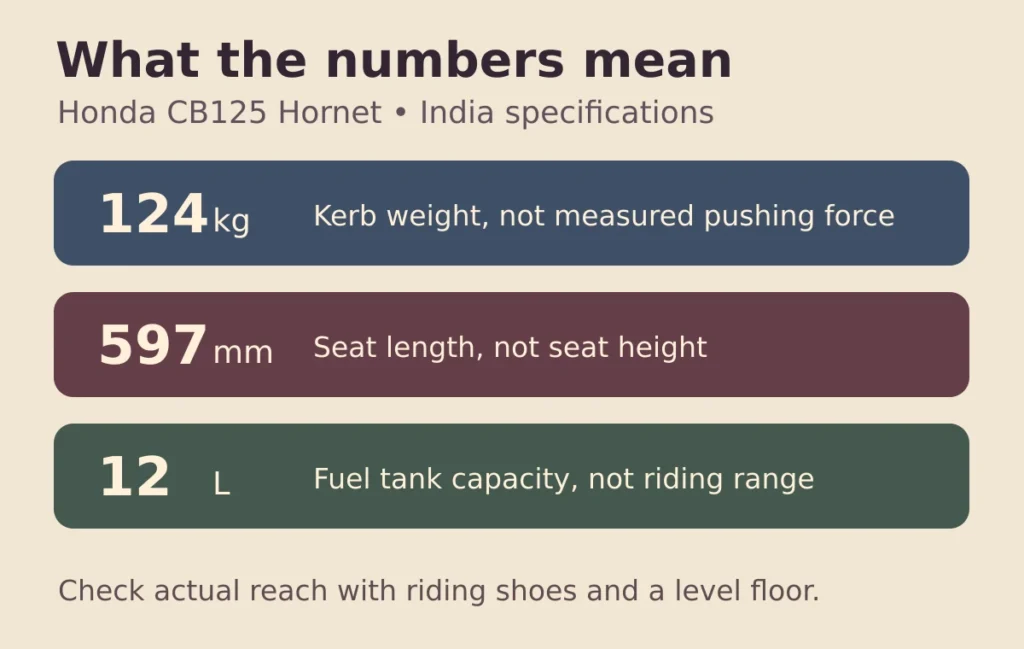
Honda lists the India-market CB125 Hornet at 124 kg kerb weight. That is useful if you are comparing motorcycles on paper, but it cannot tell you whether you will feel confident moving this bike backwards into your parking space. The quickest way to find out is to try the exact motorcycle at the dealer, on a clear, level floor, with the engine off and a staff member alongside. Take the shoes you normally ride in.
The 597 mm figure is not the distance to the ground
Honda’s CB125 Hornet specifications list a 597 mm seat length. That measurement runs along the seat; it does not tell you how far your feet have to reach down. Do not treat it as seat height or compare it with another bike’s seat-height figure. If the number you saw online came from a page that also lists the Shine 100 DX, check the model name on the row before using it. Honda introduced both motorcycles in the same announcement, but they have separate dimensions.
The other number to distinguish is the 12-litre fuel capacity. It is not the amount of fuel in the showroom bike, and it cannot be used on its own to estimate your range. For a fit decision, the model specification and an actual check on the floor answer different questions.
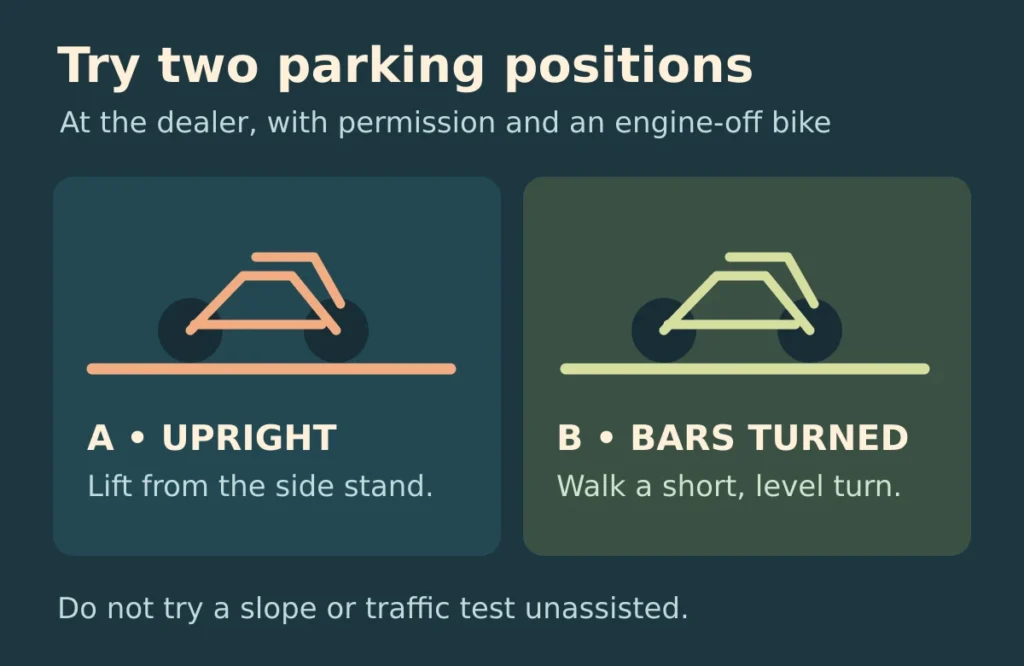
First check: Seat reach with the bike upright
Ask the dealer to steady the motorcycle while you sit in your normal position. Let your knees and hips find the position they would take at a stop instead of sliding unnaturally far forward just to reach. Pay attention to whether the seat edges push your legs out, not just whether your boots touch the floor. Two bikes with similar quoted seat heights can feel different because the reach is around the seat as well as down to the floor.
One useful question to ask yourself is whether you can support the bike on a solid foot without twisting away from the handlebar or having to lean substantially. This is not a universal rule that both feet must be completely flat; it is a check that you have a repeatable, comfortable stance. If you feel unstable, ask the dealer to take the weight and stop the test rather than forcing it.
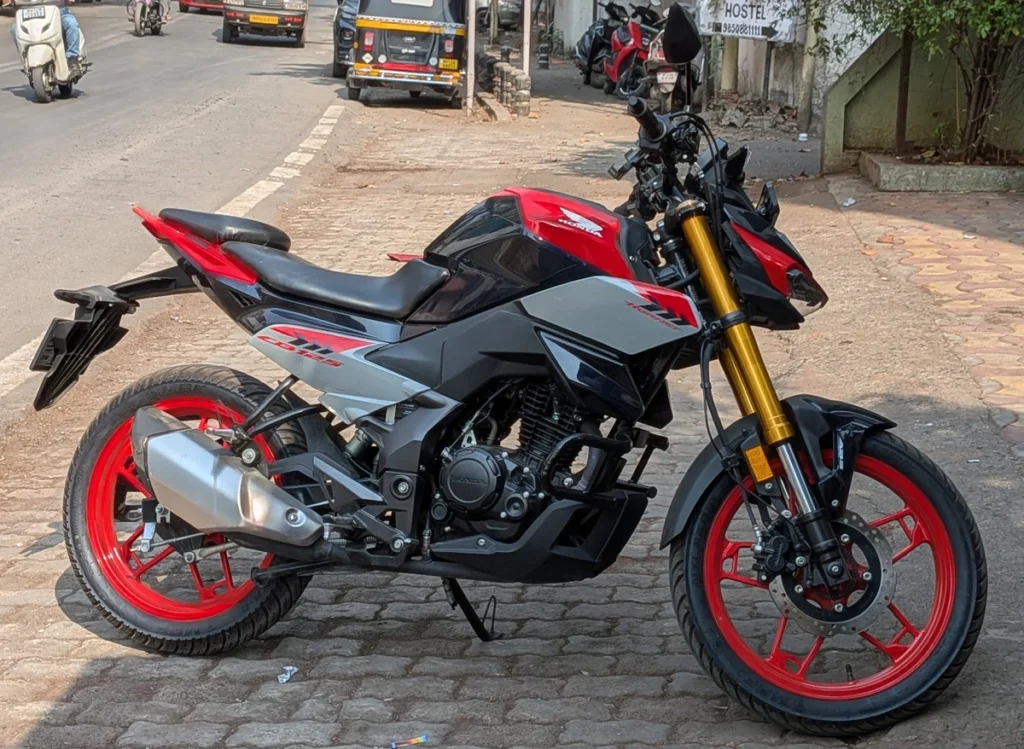
Second check: The first metre of a parking move
Parking feel changes when you turn the handlebar or move the bike from a slight lean. With the dealer’s permission and assistance, move the unpowered bike a short distance on the level. Begin with the bars straight and the bike upright, then try a small turn. If you are already struggling or the floor is crowded, let staff demonstrate instead. A cramped or sloped parking space is not a place to discover how the bike balances.
Think about what your own parking space actually demands. Do you need to pull it backwards over a lip, swing the front wheel around a pillar, or make room beside another bike? Do not try to recreate those hazards in the showroom. Use the level-floor result to decide whether you want to ask the dealer for a more representative supervised demonstration, or whether parking nose-out would be a better option. Our Speed 400 reverse-parking guide explains why an uphill exit changes the task, even on a bike you can easily hold still.
How to compare the Hornet with a second bike
Use the same footwear, same flat surface and similar parking manoeuvre on both motorcycles. Record one practical detail about each: where the seat puts your feet, how easily you can get the bike upright, or whether you need to straighten the bars before moving it. Those observations tell you more than remembering which brochure showed the lower kerb weight. Ask staff if either demonstrator has accessories or a different seat, and compare the trim you would actually order.
The Hornet’s 124 kg specification is a good starting filter. If you can keep a comfortable stance and reposition the exact bike without a struggle in a controlled test, you have a better basis for booking it. If not, test the alternative before paying a deposit. You are buying for the parking place you use every day, not the easiest metre of the showroom.
Watch the official video on YouTube
The cover is an original illustrated city parking composite using the real motorcycle in a photo by Xondikoi via Wikimedia Commons. That credited photo also appears in the story. Photo and cover adaptation: CC BY-SA 4.0. The sunny parking scene is illustrative.


