

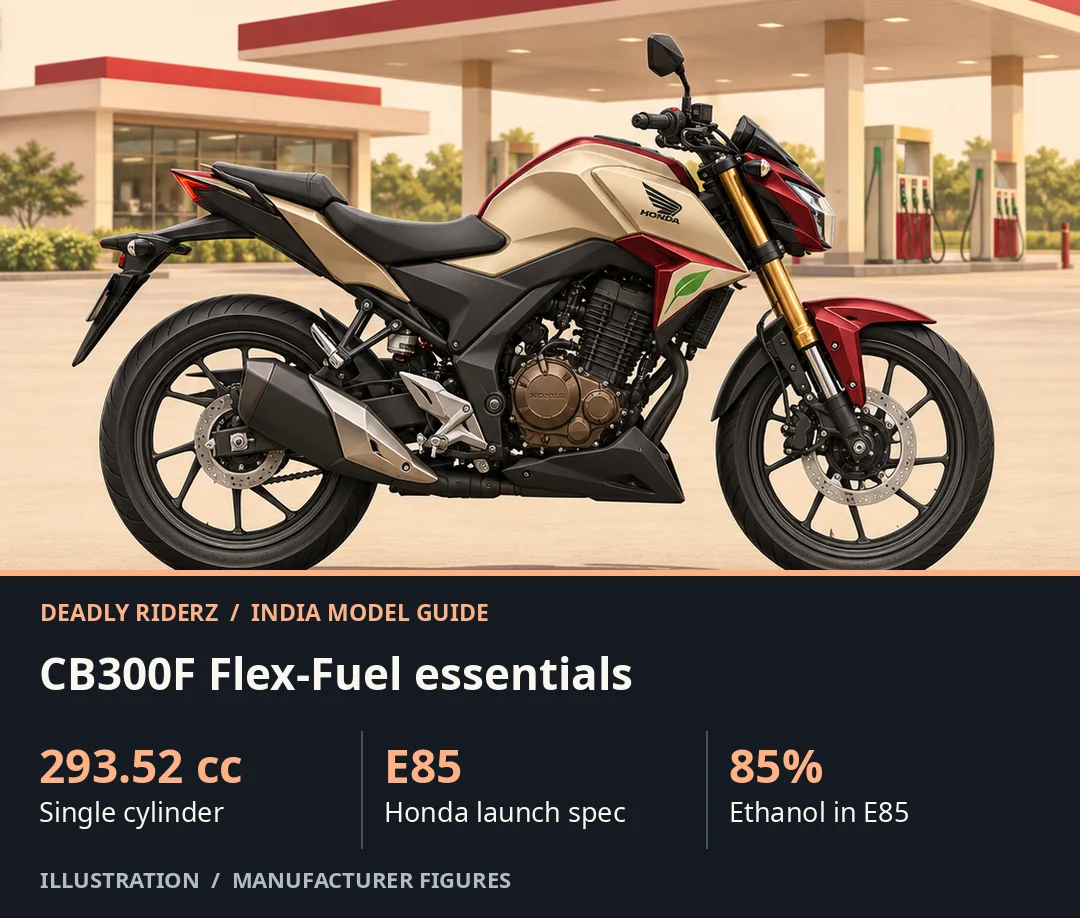
When a used Honda CB300F listing says “flex fuel,” the two photos worth asking for are the fuel-compatibility label and the owner’s manual for that bike. An E85 badge by itself gives you little to work with when the seller is relying on memory and the fuel pump near your home sells a different blend. Honda launched a distinct CB300F Flex-Fuel in India in October 2024. A buyer today should establish which motorcycle is for sale, what fuels Honda permits for that unit, and whether the extra flexibility fits the places they ride.
Highlights
- The CB300F Flex-Fuel was a separate India-market version launched in October 2024.
- E85 describes a petrol blend containing up to 85% ethanol in Honda’s launch context. Check the exact motorcycle’s documentation for its permitted range.
- A launch price is historical. Get a current quote or used valuation based on documented variant, condition and support.
Confirm the variant first
The Flex-Fuel and the standard CB300F share the basic shape and much of their hardware. Listing photos, colour and seller descriptions are weak ways to identify the variant. Ask for the invoice or purchase paperwork, the details from the vehicle label and the manual that came with the motorcycle. Then have a Honda BigWing dealer confirm the variant from the VIN before you put down a deposit.
Autocar India’s October 2024 launch report notes a change to the display to warn about ethanol content above the intended limit. That is a useful clue for a buyer, but a dial photo alone remains incomplete evidence. An instrument panel could have been replaced, and a seller may have uploaded a picture from another listing. Ask a seller of a used unit to demonstrate its startup sequence and supply service records with matching vehicle details. For a new or older-stock unit, ask the dealer to confirm the build date, warranty start date and what will be written on the invoice.

Read the fuel label at the pump
The number in a blend name refers to the ethanol portion. E20 and E85 therefore describe different blends, and a flex-fuel label on one model cannot establish compatibility for another. Use the fuel requirements in the manual for the exact unit you buy. If information on the fuel filler and in the paperwork is inconsistent, ask Honda to resolve it before experimenting. A pump dispenser carrying a higher-ethanol blend also tells you little about how reliably that blend will be stocked along your route.
Make a local list of stations you actually visit and confirm what their dispensers offer. If your weekday riding is mostly in one city, local fuel availability matters more to the buying decision than a station close to a highway you ride twice a year. If alternate blends are important to the reason you want the bike, verify those stations before assigning any financial value to that capability.
Compare real running costs
Use rupees per kilometre to compare fuels under similar conditions. For a hypothetical example, a fuel at ₹100 per litre used at 30 km/l costs about ₹3.33 per kilometre. A second fuel at ₹90 per litre used at 25 km/l costs ₹3.60 per kilometre. These are made-up prices and efficiencies to demonstrate the calculation, with no claim about either blend’s market price or the Honda’s mileage. The example shows why a lower price on the dispenser can still cost more on the road.
If you have a reason to compare two manufacturer-approved fuels after buying the bike, record the odometer distance and the refill quantity across several tanks on similar routes. Note a change from long highway rides to several short trips and compare like with like. A range reading after a single fill is a weak basis for choosing how to fuel the bike.
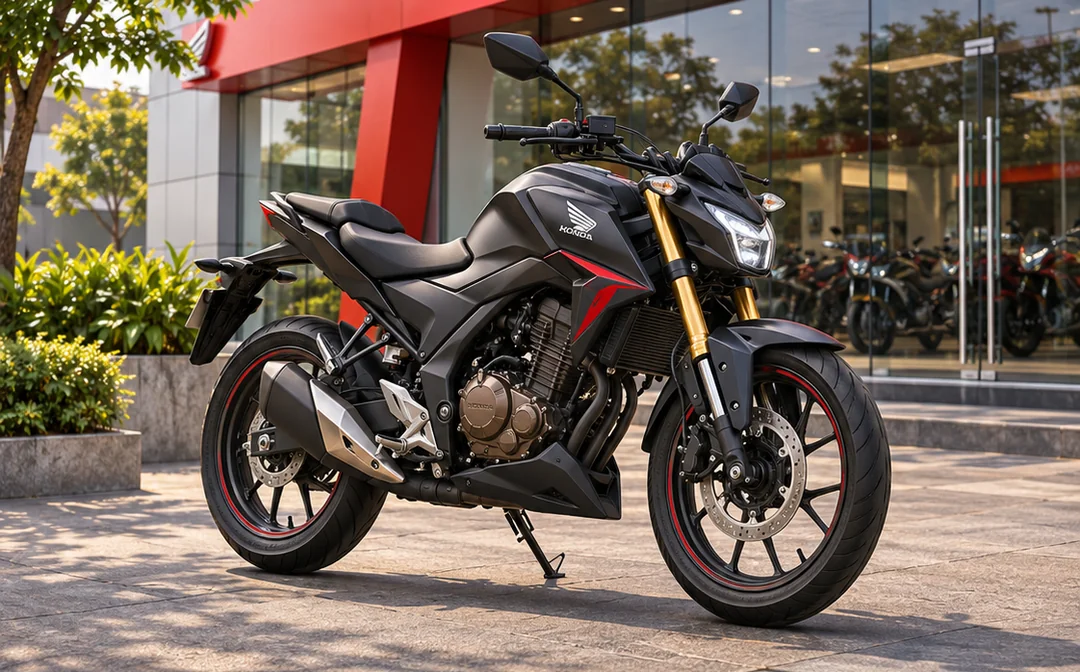
See the launch-era bike and cockpit, then confirm the paperwork on the individual unit you are buying. Watch 91Wheels’ CB300F Flex-Fuel launch walkaround.
Buy on condition and support
Autocar India and BikeWale reported a ₹1.70 lakh ex-showroom launch price in 2024. Use that as context for the model’s introduction. Obtain a current written price and confirm stock with a dealer if you are considering a showroom bike. For a used one, inspect service history, tyres, brakes and the instrument cluster, and have a reputable workshop check it. Ask whether variant-specific parts are available locally and what the expected order time is.
If the CB300F is on your list because you want a comfortable city Honda, check your usual route and passenger needs before deciding. Our Honda NX200 buyer’s guide covers a different riding position and the questions worth asking on a practical test ride.
The buying decision
A documented CB300F Flex-Fuel is worth considering when the price, condition, local support and everyday ride suit you. Put documentation and the condition check first. Treat fuel flexibility as an extra you can value after confirming what the motorcycle permits and what your local pumps carry.
Sources
Honda’s original India launch announcement
Honda CB300F Flex-Fuel brochure, archived by autoX


