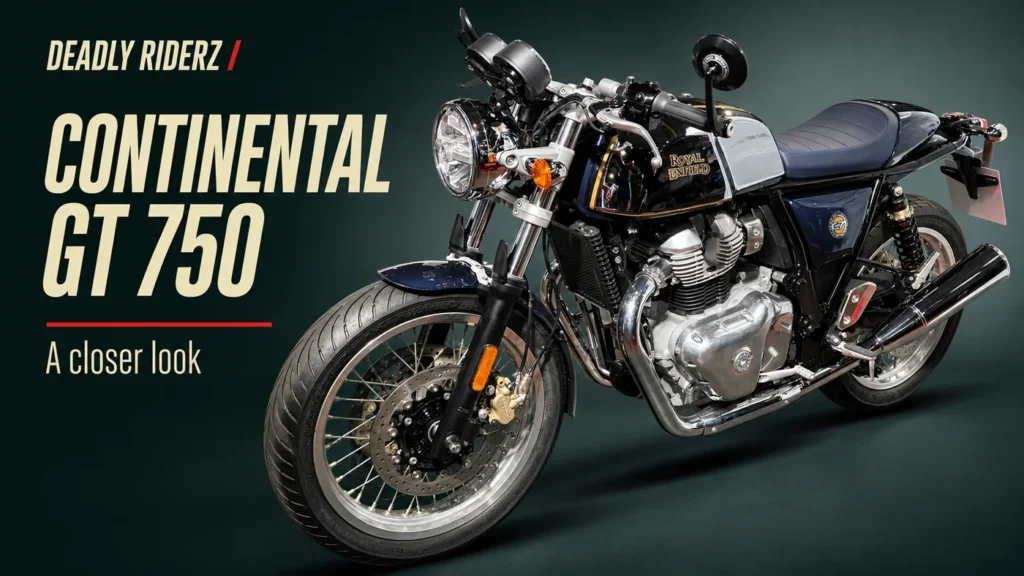

If you own a Continental GT 650, you already have much of what makes the new 750 tempting: the long tank, the twin exhausts and the sight of two round clocks above the headlight. So what would you actually gain by changing bikes? Start at the front wheel. The second brake disc tells you more about Royal Enfield’s direction for the 750 than the extra digit on the side panel.
The hardware you can compare today
| Detail | Continental GT 650 | Continental GT 750 shown at EICMA |
|---|---|---|
| Engine | 648 cc parallel twin | 743 cc parallel twin |
| Front brake | Single 320 mm disc | Twin front discs |
| Cockpit | Twin round instruments | Twin analogue needles with an inset TFT |
| Bodywork | Classic exposed headlight | Exposed headlight or quarter fairing, depending on finish |
The 650 figures come from Royal Enfield India. Royal Enfield unveiled the 750 at Milan, and Autocar India’s inspection of the show bikes documents the brakes, clocks and wheel combinations. This comparison uses those production-show details. Riding impressions will have to come from a road test.
The engine question is about overtaking
The increase is 95 cc, just under 15 percent. For a 650 owner, the revealing moment will be rolling on the throttle behind a slower vehicle in the gear you normally use. Does the 750 pick up cleanly where you would usually change down? Is it still as easy to meter out a little throttle in town? The 750 shares its basic engine with the Himalayan 750, but the GT shown in Milan uses a cable throttle and twin exhausts. Transplanting the Himalayan’s published output figures into a GT comparison would skip over those differences.
What the second disc can tell you
Two discs give the front brake another surface over which to distribute heat. The spec sheet can tell you that. It can’t tell you how much pressure the lever needs, how progressively the brakes bite, or how confident you feel feeding them in on a wet commute. Those are better reasons to pay attention on a familiar dealer test route than the sight of an extra rotor alone.
Look past the paint before choosing a 750
The blue show bike pairs its small fairing with alloy wheels and tubeless tyres. The red bike also wears a fairing, yet it sits on wire spokes with tubes. The chrome, unfaired version also uses spoked wheels. That makes the wheel choice worth a second look if you regularly ride outside town and already have a preferred puncture-repair setup. Confirm the wheel and tyre markings on the exact Indian variant you’re offered.
Look at the bars in BikeWale’s Milan walkaround, then compare how far the rider has to reach on each version. Our faired and unfaired GT 750 guide goes further into that choice.
Would we trade in a 650?
If you love your 650 on Sunday mornings but dislike the weight on your wrists by Monday’s third traffic light, try the unfaired 750 first. Spend time with the bars at full lock and your feet on the pegs. If your only complaint is having to downshift on two-up rides, make roll-on response your deciding test. A larger engine can’t answer an ergonomics complaint, and a beautiful fairing can’t tell you whether an overtake feels easier.
Our take: keep a well-sorted 650 until a ride on the exact 750 you want answers one specific frustration. Then compare the dealer’s written on-road quote with a real offer for your current bike. That difference is the price of the upgrade you actually felt.
Cover illustration by Deadly Riderz, adapted from a photograph by 802xr, used under CC BY 4.0.

